Creative spirits

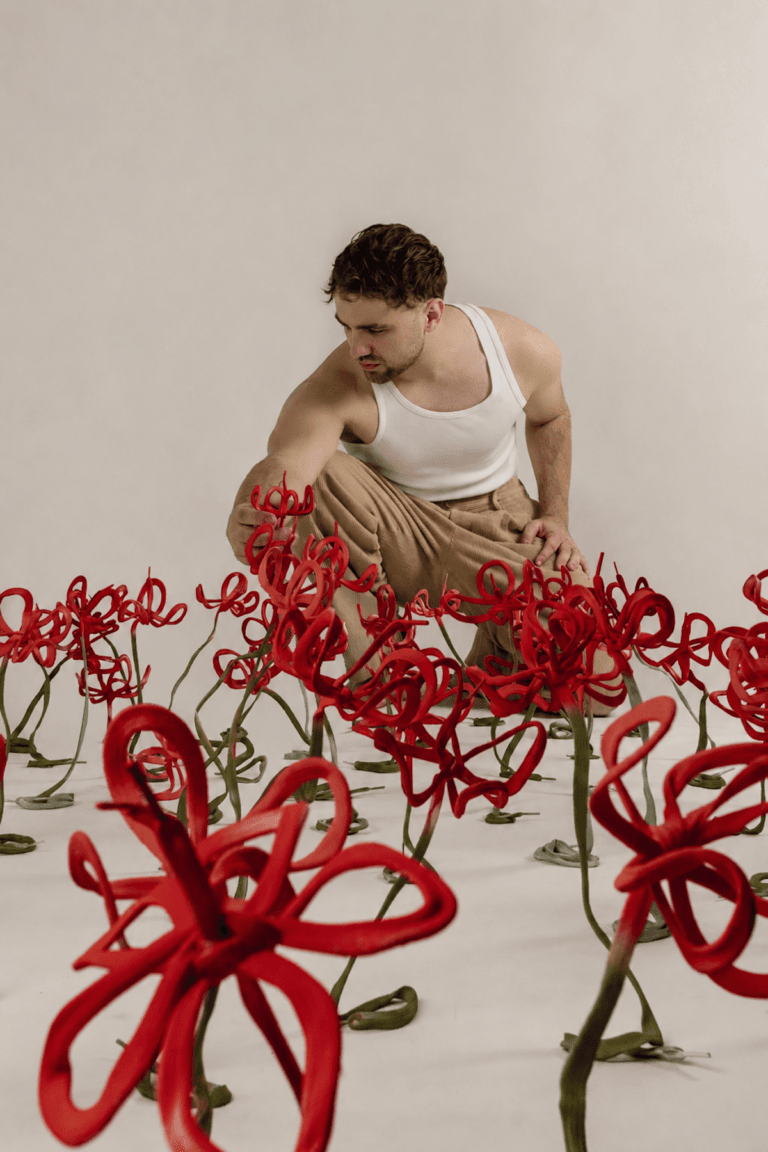
Man in a white tank top crouches among tall red curling flower sculptures in a neutral studio.

Artan Rushidi, contemporary artist shows at Le Bar à Lunettes

The multidisciplinary artist has created an installation at the optical boutique Le Bar à Lunettes in Liège

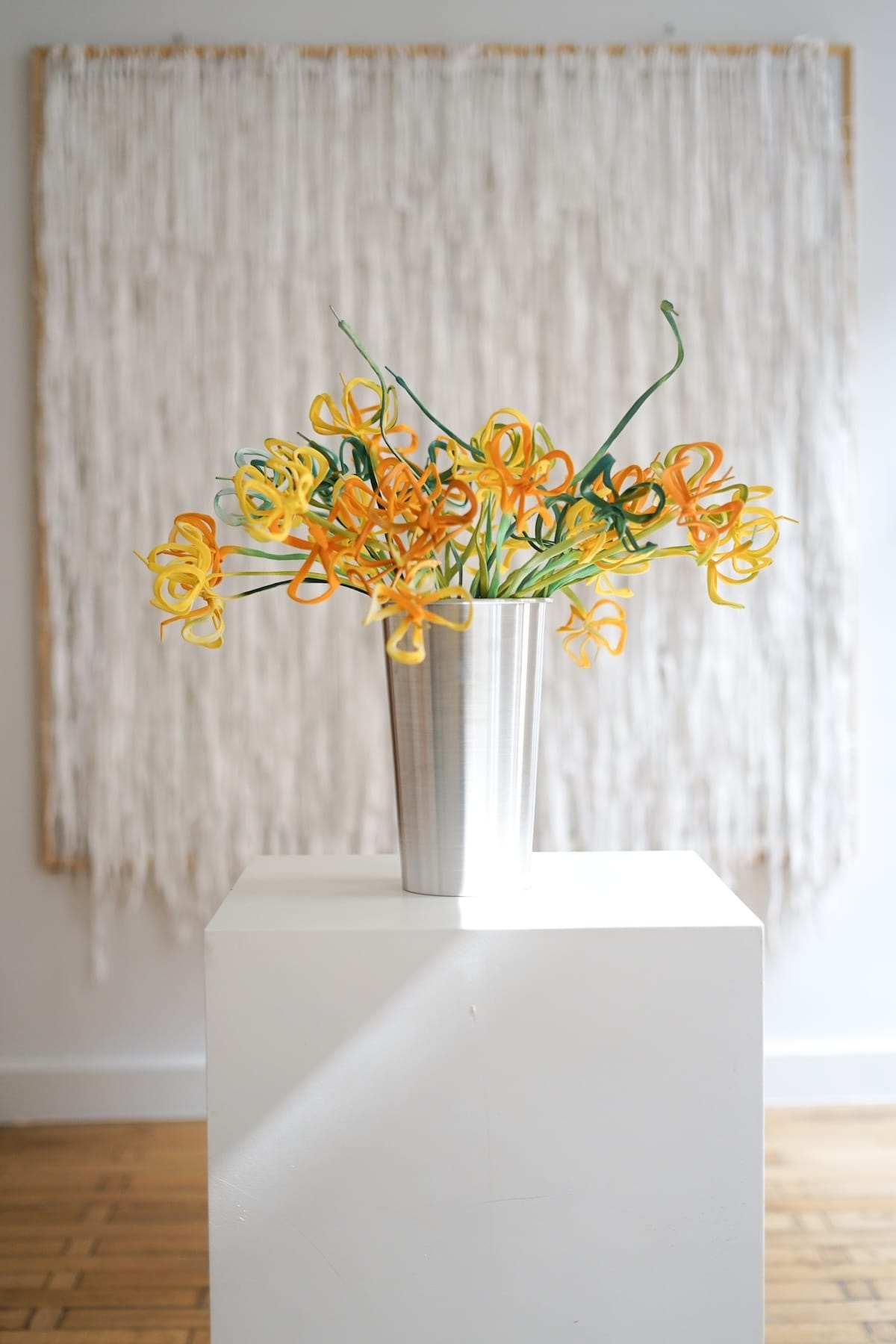
After beginning his studies in architecture, Artan Rushidi became a contemporary artist. Today he creates artworks exclusively using shoelaces. “My work consists of tying them, assembling them, and making them bloom. I have always enjoyed standing apart, and shoelaces gradually became my medium of expression. It is a new language, but one that deeply reflects who I am.” Rushidi has worked in collaborations before, creating an installation with the famous Belgian crystal manufacturer Val Saint Lambert. “We integrating a floral knotted artwork into one of their crystal vases. It was a meeting between two forms of craftsmanship, two materials, and two different worlds.”

“It was a first experience for me, but I hope it will not be the last,” he told Eyestylist. “I enjoy challenges and the opportunity to look at things differently, to connect my work with other worlds, other environments, and to reach a different audience. This collaboration allowed me to discover a rich, inspiring, and fascinating universe.”

His latest installation is showing at Le Bar à Lunettes (www.lebaralunettes.be) in Belgium, a design boutique specialising in luxury eyewear and brands like Ahlem and Lapima. “Occupying a space, taking installations out of the studio, and seeing them come to life elsewhere is a completely new experience. I was very happy to create this first project with Le Bar à Lunettes. Thibaut has a strong artistic vision, with a slightly futuristic approach that resonates with my own practice.” Above: portrait of the artist

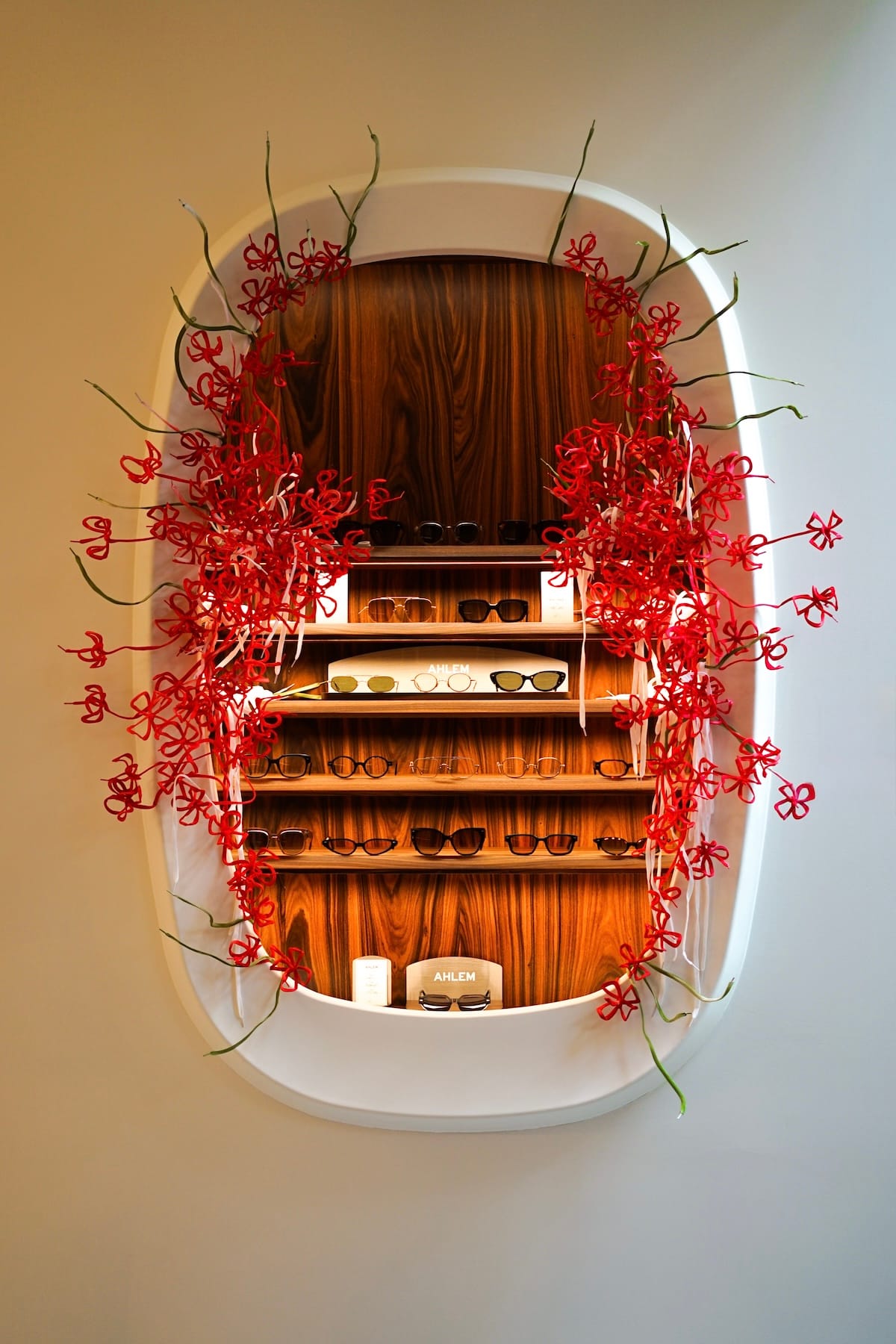
Le Bar à Lunettes  in Liège – Artan Rushidi’s floral work showing at the store

The artworks displayed in the boutique were created especially for Le Bar à Lunettes, which goes beyond being a simple retail space. Upstairs, an exhibition area provides a gallery space for the artist’s series of knotted canvases. The idea was to create a journey, inviting visitors to see things differently and “perhaps also to become connected to one another.”

“I would love to see more collaborations emerge, explore different themes, and build bridges between optics and my work with shoelaces,” says Artan.  “Sometimes a simple encounter opens a door, and that is exactly what happened with Thibaut. I was honoured to install my work in his boutique during this “Spring” exhibition.”

Oval white display case with wooden shelves holding rows of sunglasses, framed by red decorative flower garlands.

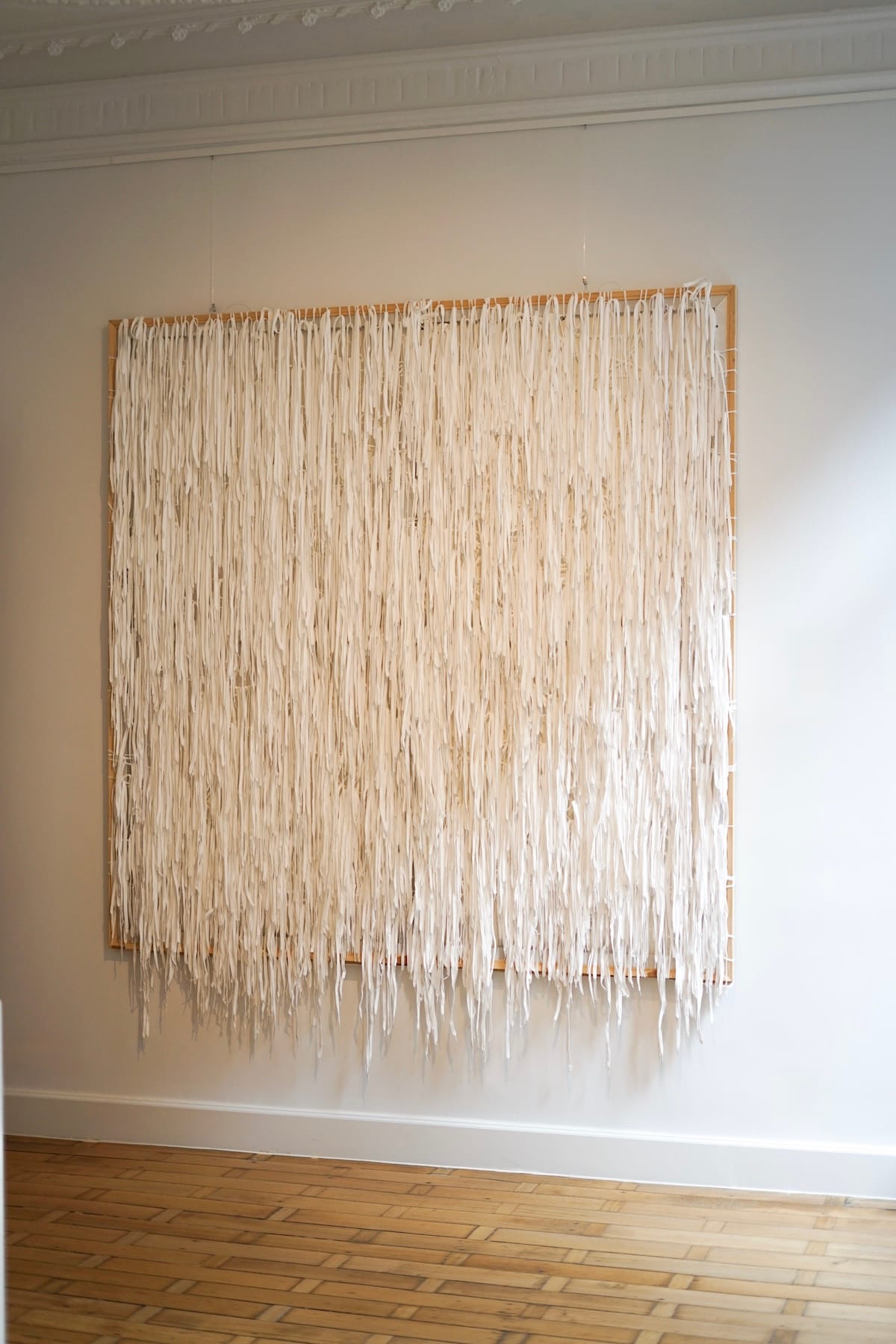
Asked about how the installation unfolded, Rushidi said the creation process varies depending on my state of mind. “I can spend a few days on a piece, or several weeks. Some works contain kilometres of knotted shoelaces integrated into formats reaching up to two by two metres. Each artwork requires time, repetition, and a form of almost meditative patience.”

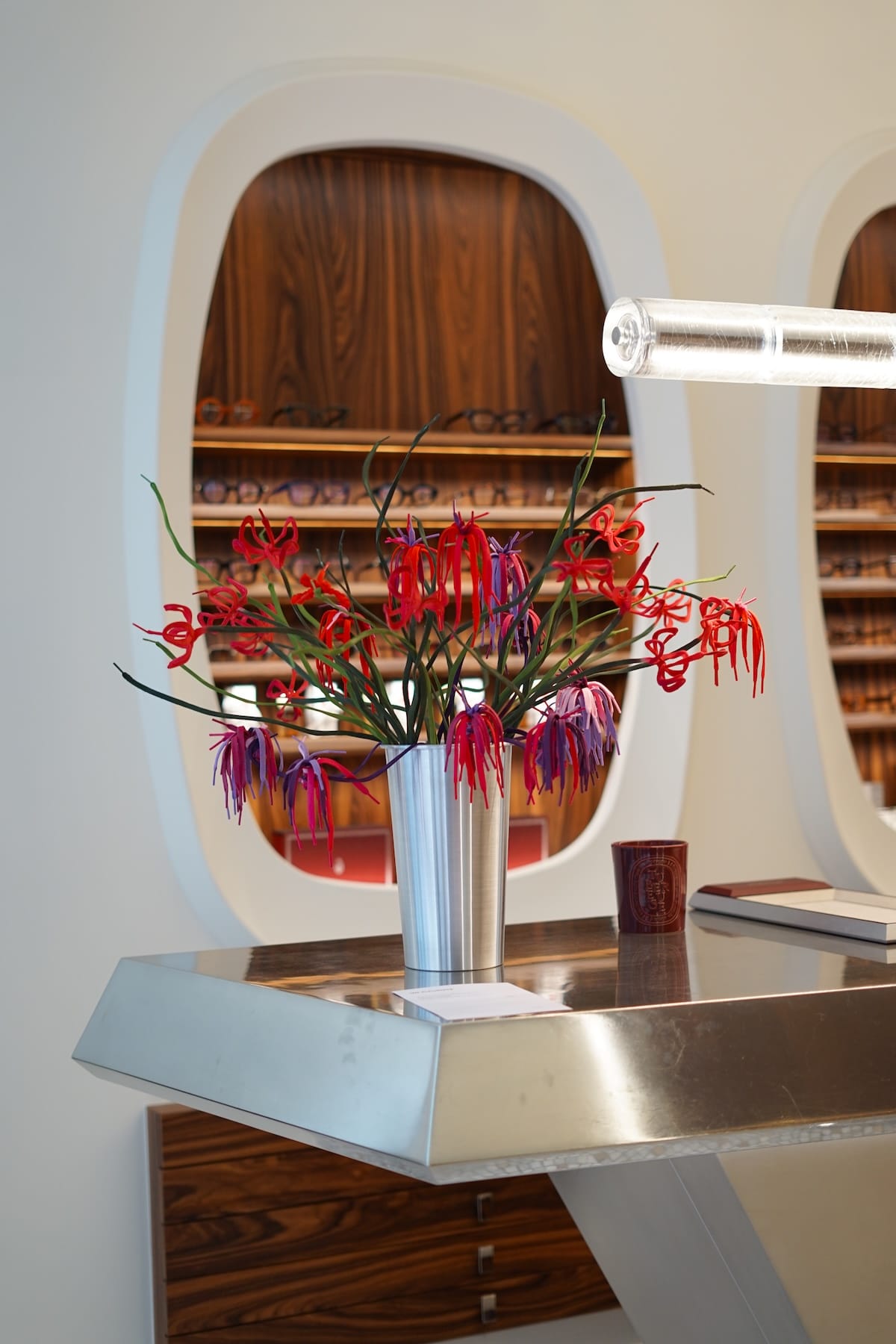
Knotted canvas by Artan Rushidi, shown in the gallery space at Le Bar – and bouquet of flowers

Asked to explain how he thinks a retail space can lend itself to an experience of art, he told us: “I truly believe that art belongs in these spaces. I like the idea that my work can surprise people, spark curiosity, and create questions among visitors entering the boutiques that host my pieces.

Sometimes you need to surprise people to leave a lasting impression, to bring art into places where it is not expected. It is an exciting challenge to occupy such unique and beautiful spaces. These encounters give the artworks a new life and create an unexpected dialogue with the public.”

Find out more about work by Artan Rushidi at www.artanrushidi.com

This Eyestylist exclusive feature was written by Clodagh Norton and published on 26th May 2026. All rights reserved. Photos by kind permission of Artan Rushidi. Eyestylist.com does not use artificial intelligence to write or edit copy published on this website.

Martin Guentert, Ørgreen Optics

Trained as an industrial designer, Martin Guentert is the Head of Design at Ørgreen Optics. With over 16 years of industry-defining experience, including pioneering laser-sintering techniques, Guentert is one of the optical industry’s foremost product designers. We asked him about his current approach to design in his work at Ørgreen Optics, Denmark’s premium eyewear brand.

When you joined the Ørgreen team in 2024, you talked about wanting to make the brand “future-proof” through even more innovation. Could you explain in a little more detail your production direction at Ørgreen so far? When I joined, Ørgreen already stood for great competence in colour and design and for highest quality in product and service. And while our titanium lines are still what we are most known for, since then, products like our ACETATE CUT collection with its flex hinge, and fresh shapes and a more sculptural approach to the QUANTUM HIGH collection – with models like MEGAHERTZ – have widened the horizon.

Last autumn, we launched a new family of frames called NYHAVN. Because they are made of stainless steel and with a simple monocolour concept, we were able to develop and add a feature hinge to the package and still keep an entry price level. It speaks to a slightly younger audience and opens up new clients to Ørgreen. Generally we try to sharpen our product identity along with a brand overhaul, which you are starting to see in everything we do.

And we won’t stop there. A stronger emphasis on sunglasses will help shape our brand in the near future and we will have more exciting titanium news this year. So watch this space… Above: portrait of Martin Guentert, Ørgreen Optics.

Ørgreen Optics offers a selection of high quality eyewear collections with timeless designs

What do you feel are key directions in eyewear in 2026, and how does this apply to the Ørgreen Optics’ collections? Honestly I don’t spend much time on trend research. I mostly trust my intuition, my team and our own statistics. On the Ørgreen side of things you are going to see that we lean into more sculptural details across sheet titanium, acetate and 3D printing. Well-placed chamfers and surface details can really enhance a great cut. On the other hand, in NYHAVN we are also trying to simplify and offer something that is reduced to outline and colour.

You have had an incredible career in eyewear design so far, first at MYKITA and now at Ørgreen. What did you originally train to be and how did you get into eyewear? I studied industrial design. I had done one eyewear project as a student, which was exhibited in Berlin and discovered by the MYKITA founders. They took me on board. I learned a tremendous amount and was able to specialise, experiment and grow with them. And after 16 years it was time for me to write a new chapter in a new city and I took the challenge to lead the design team at Ørgreen. Generally we try to sharpen our product identity along with a brand overhaul, which you are starting to see in everything we do. Although I was trained more as a generalist, I never wanted to return to classic industrial design. The longer I am in eyewear, the more interesting it gets.

What draws you to the eyewear product from a design point of view? We design fashion items, medical devices, lifestyle statements all at once. And we do it for the most sacred area on the human body, the eyes. To do this with the right respect for the wearer, expertise and brand awareness is no small feat. We’re not saving lives here, but we make everyday companions that enable our wearers to see better and express themselves. It’s a very intimate thing.

What are your favourite contemporary materials and where do you  see the future of eyewear design headed?  I love working with additive manufacturing. I had a chance to pioneer 3D printing in the eyewear world back in 2011 and I still learn new ways to use it. Although 3D printing has its limitations, this production method represents the most direct way for me to shape what’s in my head. And this is also a field where most incremental improvements are being made, almost every month. Smart eyewear is making some interesting developments, but is still far from ubiquitous or unobtrusive. The industry needs more R&D here to really interest large amounts of people.However, the general eyewear market will hopefully focus on issues of sustainability first, especially in the field of preconsumer waste. And forcing the big players to have better answers here is a task for every designer and every consumer.

Ørgreen Optics – Western 3D Ring

Bright colours or a minimal palette (as they coexist in 2026) – what is your preference and how do you feel customers are now approaching colour in eyewear? There are no simple recipes here. It’s not about a certain palette, it’s about consumers understanding what you do and feeling a connection. What I am looking for is clarity and emotion. If the cut of a model is very austere and minimal, the emotion can be injected with colour, even if it’s just a small detail or on the inside of the frame. But a paint bucket is not a panacea for boring designs. Me personally… I’m a monocolour kind of guy.

When you are not working, what are your interests and do they somehow inform your work? I love great food and Copenhagen seems to be its capital. I like to make the act of eating a reward for myself and a joy to share with others. I like to always have a craft project going on. The one thing I keep coming back to with passion is costume making. I enjoy learning multiple techniques, from integrating electronics to sculpting with foam clay or classic sewing. I love the character design and people’s reactions to it. And yes, that absolutely informs my work.

When you look back at eyewear history, what product/products do you most admire or which eyewear designer do you look at as both original and inspirational? Of course there are seminal designs in eyewear, but the designer personalities I refer to are often generalists. If we only ever look at our own industry, the risk of generic and referential ideas is too high.Jasper Morrison has been an important influence for me as an industrial designer. And lately I have looked more at Danish designers like Finn Juhl or Grete Jalk to get a more nuanced understanding of the Danish design tradition, which we are a part of.

To find out more about the Danish eyewear brand Ørgreen Optics at www.orgreenoptics.com

This is an exclusive interview by Eyestylist.com. All rights reserved.

Yoshinori Aoyama: “a new perspective, beyond existing values…”

The eminent Japanese eyewear designer, Yoshinori Aoyama is well-known as the Founder of FACTORY900, a multiple award-winning Japanese eyewear label. He began the label in 2001 as Aoyama Optical’s ‘own brand’ and since that time he has been involved in all aspects of running the brand and developing its success in Japan and abroad. In 2023, Yoshinori Aoyama started his eponymous label, a collection that takes a new approach to titanium by exploring all its possibilities with depth, creativity and the innovative study of spatial design. Eyestylist.com was priveleged to find out more in a first interview exclusive about the launch of this distinguished eponymous collection.

Can you explain briefly your family connection in eyewear, and how eyewear design has become a focus in your life? I was born into a family that has been involved in eyewear making for three generations, starting with my grandfather. There was a factory right next to our home, so I grew up surrounded by the manufacturing environment and watching craftsmanship very closely in my childhood. Perhaps because of this, eyewear always felt like a natural option within my life.

When I was a child, the adults around me would often say, “Your father is a genius.” As I grew older and began helping out at my father’s factory, I came to truly understand the greatness of both my grandfather and my father, and the meaning behind those words. Anyone who has been involved in eyewear manufacturing can immediately recognize the excellence of what Aoyama Optical produces simply by holding one of our frames. It was at that time that I made the decision to work in the eyewear industry seriously as my chosen profession.

Your first own label was FACTORY900. How old is the brand and what is its focus today? Give us a little summary of how this brand has evolved? FACTORY900 celebrated its 25th anniversary last year. Since the brand’s founding, my constant goal has been to create “beautiful eyewear”.  Building upon the specialized acetate craftsmanship established by my grandfather and refined by my father, we manage every step of production in-house to bring our vision to life.

By making full use of acetate as a material and pushing its possibilities to the absolute limit, FACTORY900 is known for its sculptural and avant‑garde forms. The brand has received numerous international awards, including two Silmo d’Or prizes and an iF Design Award. At the same time, we have continued to evolve through active collaborations with brands such as theo, Lexus, and Undercover.

Yoshinori Aoyama: exquisite Japanese craftsmanship and creative ingenuity + innovation converge

The new eponymous label YOSHINORI AOYAMA launched in Japan a few years ago. What is the concept and how did it come about? YOSHINORI AOYAMA made its debut at Silmo 2023 (A/W). The core concept is ambivalence. When it comes to FACTORY900, I spent many years focusing intensively on acetate as a material because of our family business.  At the same time, however, I had a strong desire to challenge myself with different kind of materials.

YOSHINORI AOYAMA is an all‑titanium collection. By working with titanium, I feel my design expression has expanded significantly. I found it extremely fascinating, and I am dedicating myself fully to exploring the possibilities of titanium.

What materials, special features and innovative techniques are used in the production of your Yoshinori Aoyama frames? YOSHINORI AOYAMA collections are primarily with titanium, as well as 18‑karat gold. While FACTORY900 is known for sculptural forms, YOSHINORI AOYAMA is defined by spatial design. Although their expression is different, the philosophy remains the same: to create beautiful eyewear.

By separating the frame from the lenses, we introduce free, three‑dimensional curves into space—an idea that challenges conventional metal‑frame design. Technically, this work is supported by the high level of craftsmanship in Sabae, Fukui, Japan. In our production meetings, they tell me the designs are  ‘too difficult’ or ‘take too much effort.’  But it is precisely this complexity that we overcome together, step by step, to bring YOSHINORI AOYAMA’s vision to life.

JISCO
Seraphin Shimmer
DIFFUSER Tokyo
Article One
SILMO Paris - The Optical Fair. 25th - 28th September 2026
SALT
TVR True Vintage Revival
MOREL
Look
FACE A FACE
Blackfin
OTIS Eyewear
ERKERS
J.F.Rey 40 Years
LOFT Santa Monica Show October 16th and 17th
LAMARCA EYEWEAR
theo eyewear
MIDO 6-8 February 2027. Welcome to Eyewearland
Götti Switzerland
rolf. /></a></div></div><figure id=
Yoshinori Aoyama: a new direction for titanium eyewear

Do you already have optician stockists for this collection outside Japan? How are you working with partners in the rest of the world? The YOSHINORI AOYAMA collection is currently available in 14 countries across Asia, Europe, and the United States.  Depending on the country, we work either through local agents or, in regions without agents, directly with individual retailers. We collaborate with partners with flexibility according to the conditions of each market as we expand internationally.

 What is your priority with this collection and its positioning in the luxury segment? Creating beautiful eyewear is a central part of my design philosophy, and it is something I value highly. I aim to let this approach naturally shape how YOSHINORI AOYAMA is perceived within the luxury eyewear market and express a quiet, essential sense of luxury—something that resonates deeply with those who understand and connect with it.

Yoshinori Aoyama: new collection in titanium – made in Sabae

What have you added in the collection since we first saw it in Japan in October 2023? This is my first time working with titanium, so I am currently spending a lot of time exploring and understanding it through my collection. I am not too influenced by the market, and am conducting various experiments to find out how far I can go with titanium as a material.

How would you define the reaction to the collection in Japan so far? Overall, the response in Japan has been very positive. I know that preferences differ depending on the retailer, and the end user, and those differences become even more pronounced in a global market. That said, I don’t believe it is realistic—or even necessary—to create something that appeals to everyone.

What matters more to me is whether the collection can introduce a new perspective beyond existing values and conventions. Seen from my current standpoint, I feel the feedback we have received has been very encouraging, and I am satisfied with those responses.

Yoshinori Aoyama will exhibit at Eyecon Show in New York from 6th to 8th March 2026.

Find out more about Yoshinori Aoyama at https://yoshinoriaoyama.jp

This is an excluisve feature by Clodagh Norton at Eyestylist.com, published on 3rd March 2026 (AI has not been used). All rights reserved.

Fabian Burgard, fashion photographer, co-founder, Burbas

Fabian Burgard co-founded Burbas with Max Bastian as a full-service creative studio based in Cologne. Working across photography and video, the team produces content ranging from e-commerce shoots to major campaigns for clients in Germany and abroad, with a growing presence in the eyewear sector. With AI beginning to influence how the perfect frame is captured, Eyestylist asked Burgard to share his perspective on photography, eyewear, and the future of image-making in luxury fashion.

When did you start specialising in eyewear and how does this style of photography fit with your expertise? I first worked for an eyewear brand in 2019. It fits well with what I do, as I also shoot in other areas of fashion. Outside of work I also developed a big interest in the fashion industry as well (even if my own outfit looks pretty much the same most days). A real “expertise” for eyewear came over time. Glasses are a tricky product: they’re reflective, often super delicate, and the photographed angle makes a huge difference. Over the years, I think I developed a feel for what makes a frame look right, how to place and light it. So it’s something that really grew through doing it and will probably keep growing.

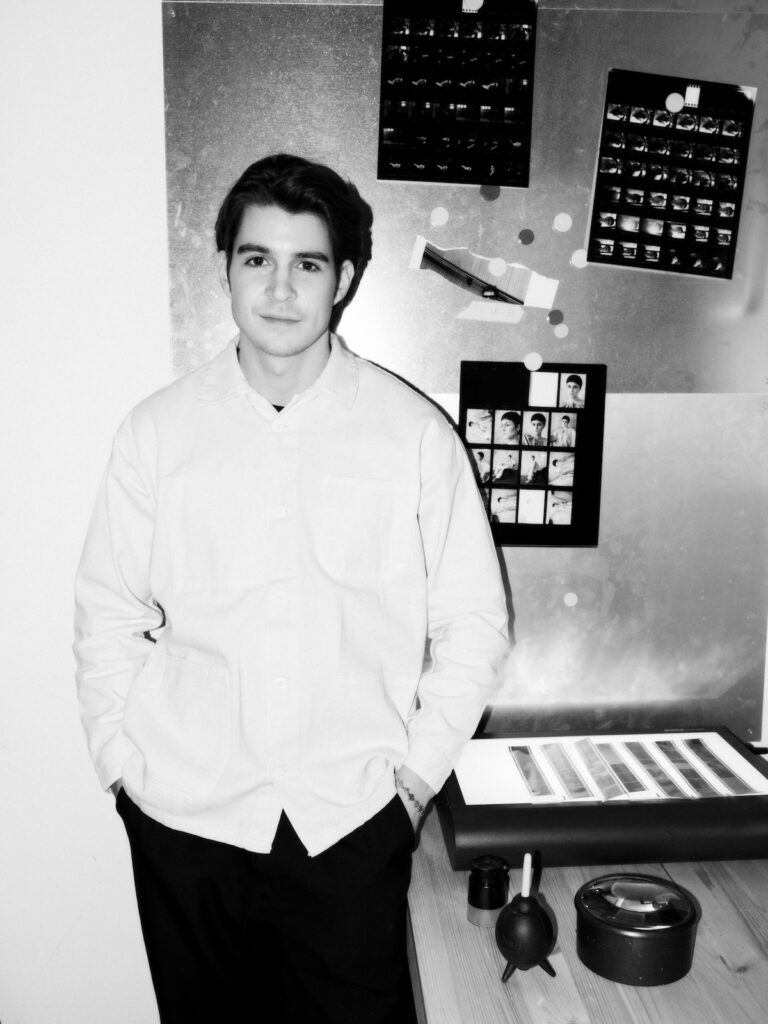
What is your view on AI and photography campaigns? Are you using AI at Burbas and what advantages have you seen? AI is a great tool, when it actually makes sense. We’ve been developing workflows that let us keep the product design consistent, to use when it serves the concept. That can make it possible to create more complex looks without blowing the budget, which is a win for a lot of brands. At the same time, it’s very client- and brand-dependent. Above: Fabian Burgard, photographer @burbas.de

Coblens Eyewear campaign 2026 – shot by Fabian Burgard at Burbas

We actually still produce full analog shoots, and we even have our own in-house darkroom for film development. The main thing for me is that AI shouldn’t override a brand’s authenticity. If a label is rooted in tradition or draws from specific decades and craft, you need to reflect that honestly and sometimes that means AI simply isn’t the right tool (at least right now). In the end, I don’t think you should ignore AI either or use it just because it is new or even hyped at the moment.

What was the latest campaign you worked on? Our latest campaign was actually a special one. It was for Coblens Eyewear (https://www.coblens.com), a label from my hometown, they make beautiful frames. We shot it at the Gerling Quarter in Cologne, a 1950s building from the post-war modern era. The location as part of the building is run by a university that’s also one of our clients, so we were able to produce there. And the architecture matched the frames perfectly, so visually it feels like a match.

Besides the video assets, we produced a fully analog photo series: shot on film, then we made hand prints in our darkroom and scanned those for the final files. It’s a workflow I love, but in this case it also fits the brand so well because it has that crafted, handmade character. With a great team, it turned into one of those productions that’s just really fun from start to finish.

Do you also do still life work and what is your opinion of still life photography for eyewear? Yes we do still life, and I love it. It’s such a strong (and easy) tool for building brand identity, especially in eyewear. For me, still life works best when it’s reduced and focused — not overloaded with as many beautiful objects as possible. Sometimes texture and framing is already enough to set the tone. Putting frames on a material that fits the brand can do a lot. Technical frames on stainless steel, brands with a heritage feel on materials that reference older interiors or architecture, whether that’s marble, a specific carpet, or something similar. If the concept is more modern or playful, you can also go in a slightly more unexpected direction. I recently saw a jewelry campaign where the product was photographed on baking paper, super minimal, and it looked amazing. In the end, I think smart, reduced choices often make the frame look stronger than an overloaded set.

Coblens Eyewear campaign, shot by Fabian Burgard  at Burbas

What’s your work goal/ambition for 2026? For 2026, we’ve got many goals. On the main side, we want us to keep producing strong work. Staying current, pushing new ideas, and doing more creative productions. We are happy to work with new brands. Partly because it’s creatively exciting to build visuals for different brand identities, and yes, also because working with new clients is always a motivating part of the job.

And then there are the smaller, personal goals: pushing my own ongoing documentary work, refining my style, and finding a few dream locations I’ve been wanting to shoot at for a long time. Right now, I’m trying to get access to a museum space in Wuppertal that I’m completely obsessed with. So if anyone there is reading this… feel very free to reach out, and maybe we’ll end up seeing that shoot on Eyestylist.com very soon.

Coblens Eyewear campaign shot by Fabian Burgard at Burbas

What is the future of photography for eyewear brands? Digital. Or Analog and Digital? I’m pretty sure it’s going to be both. AI will keep getting better, which makes it a great match for a lot of brands, and it’ll definitely lower the barrier for newer brands to create strong visuals. But at the same time, I don’t think the handcrafted side of production will ever fully disappear, especially when it comes to creative campaign assets. In marketing, it’s not only about the final image. Often, it’s also about how it was made, who was involved, and the human side of the process. That “made by real people” aspect has always been part of what brands communicate. Whether it’s a collaboration with a bigger artist people identify with, or just creatives in general behind the scenes. That human process often matters, because it helps sell the feeling around the product. Realistically, the balance will probably keep shifting further toward digital work because the possibilities are growing so fast, but I don’t see the traditional, hands-on side of production completely vanishing. There will always be brands that look for authenticity in craft and character not only in what they produce, but in how they communicate it.

To find out more about Burbas.de, click on the link: https://burbas.de

Interview with David Duralde, OGI Eyewear

15th anniversary at Eyestylist.com / Special Content: As we look back at the last 15 years in independent eyewear to mark our anniversary, we will be highlighting some of the people who have inspired us through the years – and who continue to do so – across the disciplines of eyewear design, optical retailing and related fields in the optical + eyewear worlds.

Our first ever interview on Eyestylist with David Duralde is dated July 2016 (https://www.eyestylist.com/2016/07/david-duralde/). A subsequent interview appeared in April 2019 when David was working as Chief Creative Officer at Kenmark Optical. Today, David is Chief Creative Officer of the US label, OGI Eyewear.  OGI is part of The Optical Foundry, a collective of 9 independent eyewear brands, including l.a.eyeworks, Article One and Scojo NYC.

David, we have been in close contact over the last 15 years and enjoyed following your creative role in eyewear. What have been the highlights for you in these years? For me, the greatest highlight has always been creating eyewear that genuinely connects with people—pieces that influence how someone feels about themselves when they put them on. Eyewear is intimate. It sits at the intersection of identity, confidence, and self-expression, and I’ve always been drawn to that emotional power.

Earlier in my career, I had the opportunity to work at a scale that was both demanding and exhilarating—absorbing the DNA of many fashion houses, collaborating with creative directors across cities and cultures, and translating their visual language into eyewear. That process taught me discipline, restraint, and respect for brand integrity. You learn quickly what lasts and what doesn’t.

What’s especially meaningful now is seeing how certain design gestures—details that once required spirited internal debates—have quietly endured and evolved within those brands over time. There’s something humbling about knowing your work can outlive a season, or even a generation, while remaining largely anonymous. Those years felt like a masterclass—brief, intense moments of critique and clarity from people with extraordinary instincts for taste—and I still carry those lessons with me every day.

You were appointed Chief Creative Officer at OGI in January 2020 – part of The Optical Foundry. In these last years, what have you most enjoyed working on – and what has been most inspiring? What I’ve enjoyed most is the challenge of evolution—taking a well-loved, established brand with deep emotional equity and thoughtfully guiding it forward without losing its soul. That requires intention, patience, and a willingness to rethink familiar ideas.

I joined OGI at a moment of enormous change. The pandemic accelerated shifts that were already underway: consolidation, new ownership models, changing retail dynamics, and a redefinition of what it means to be independent in optical. At the same time, many long-standing industry leaders were stepping aside, creating both uncertainty and opportunity.

Against that backdrop, The Optical Foundry became a place to ask bigger questions. How do we support independent practices in meaningful ways? How do we celebrate individuality, invest in innovation, and approach business with optimism rather than fear? The most inspiring part has been aligning with people—internally and externally—who believe that independence is not about resisting change, but about shaping the future on your own terms.

You began your optical design training at l.a. eyeworks. How do you reflect on that initial phase of your work, and how does it influence what you do today? That early chapter shaped everything. At l.a. eyeworks, the driving question was simple: Why does eyewear have to be done the same way it always has been? We questioned materials, processes, finishes—everything. New technologies weren’t used for novelty, but as tools for expression. I’ve since seen the industry move through different eras: innovation-driven design, logo-centric fashion cycles, and now a renewed interest in authenticity and story. None of these phases are inherently better than another—they simply reflect what the market values at a given time. What influences me today is the return to curiosity. Consumers are once again asking why—why this shape, why this material, why this brand. That means we, as designers and optical professionals, have to talk about eyewear differently. We need to design with intention, communicate with clarity, and offer narratives that feel personal rather than prescribed.

Over the last 15 years, eyewear design has evolved significantly. What do you see as the fundamental changes, and how will they shape the future? One of the most fundamental shifts is how eyewear is perceived. It’s no longer just functional or purely fashionable—it’s expressive. People understand that eyewear can alter how they see themselves and how they’re seen by others.As a result, my design approach has changed. Today, I’m less interested in creating objects and more focused on capturing emotion—reflecting personality, individuality, and nuance. Consumers no longer want to be walking billboards. They want pieces that amplify who they are, not obscure it. Looking ahead, I believe the future belongs to brands that design with empathy—brands that understand the wearer as an individual rather than a demographic.

Absolutely in Grey by OGI Eyewear: showy front thicknesses and wide temple profile

Colour has always been an important part of your work. For OGI Eyewear and the Spring collection, what’s new in how colour is expressed and combined? What’s fascinating right now is the tension between caution and creativity. Many suppliers are seeing strong demand for safe, familiar colours—classic tortoises, neutrals, predictable palettes. That reflects the broader economic mood. For me, that challenge becomes an opportunity.

Blanding Turtle by OGI Eyewear: the matt camouflage features tones of khaki green, light green and black

This season is about the subtle wow—introducing surprise through refinement rather than volume. Colour is used strategically: navy instead of black, nuanced greens, controlled neon accents, and unexpected touches of orange. These are balanced with grounding tones like soft greys and warm beiges. It’s about confidence without noise—designs that reveal themselves slowly.

Do you have a favourite colour palette for this year? I’ve always been drawn to green, especially when it’s handled in a way that feels approachable and modern—even for those who don’t think of themselves as “green people.” I also continue to explore rich metallics and antique finishes, which bring a sense of craft and depth while still feeling contemporary.

By Golly in Green from OGI Eyewear offers a chunky square shape with personality

What other creative projects or brands are you working on this year that you can share with us? Across brands like Article One and Red Rose, the focus remains the same: bringing forward-looking ideas into highly wearable contexts. Whether through material innovation, proportion, or colour, the goal is always to balance relevance with longevity—designs that feel current, but not fleeting.

Is there anything else you’d like to add that’s relevant to Spring 2026? Spring 2026 reflects a quiet confidence—for OGI and for me personally. It’s about clarity of vision, thoughtful design decisions, and a belief that independence still matters deeply in optical. The collection is not about chasing trends, but about offering something considered, human, and emotionally resonant—eyewear that feels intentional, not incidental.

Find out more at www.ogieyewear.com