
237 and the concept of identity
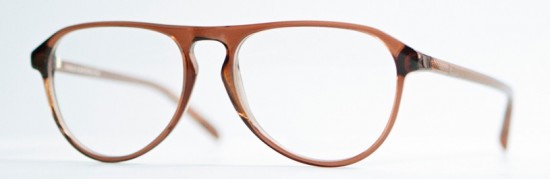
1st February 2012 Clean, pared-down sophistication is the central theme of Swedish designer Oscar Magnuson new line, 237, an adventure in acetate where we see only the essentials, pure lines and evocative, transparent colours. In conversation in Munich last month, Magnuson explained how the collection came about during a visit to 237 Eldridge Street Manhattan, New York, the address of Eldridge Optician Galleries, where he has collaborated with gallerist Rodrigo Mallea Lira of Fruit & Flower Deli.
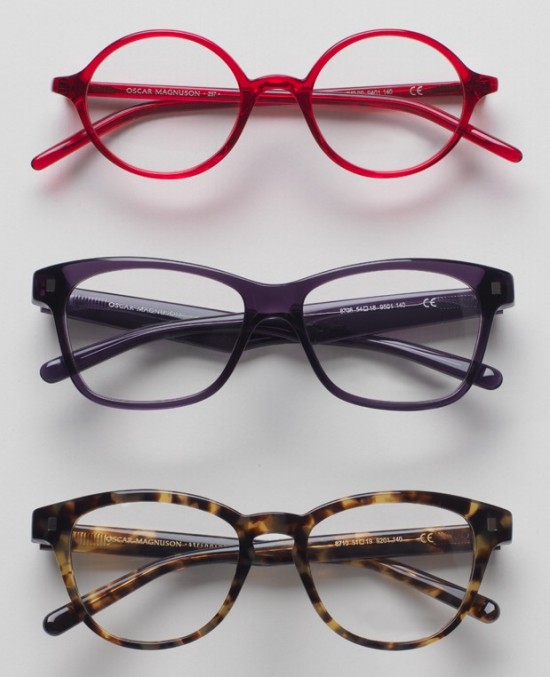
“The 237 collection focuses primarily on optical pieces, produced in high-quality Italian acetate, featuring a new feeling. My idea was to really investigate how simple I can make a frame and still preserve our expression. In the past I have worked with some more elaborate, complex shapes where I have designs making use of different thicknesses. In these 237 styles I wanted to use thinner frames of around 1.8mm, while also preserving the tiny variations or nuances in the expression of the design. Just half a millimetre can make such a difference to how a frame looks on a face. I wanted the frames to be distilled to the minimum making them easy to wear, while resulting in a strong expression but without taking over the face.
Would you say you are using signature colours? ” Generally I like to work with transparencies. I am using purple a lot in different ways. Dark purple for men is something I have explored; a transparent purple doesn’t become as heavy as a solid black, it works very well; it is interesting. I am also using the yellow which for me signals creativity and integrity. I thick I saw an interesting old guy in Paris wearing this specific yellow, it really has an extra edge and it looks creative in a sublime way.”
Can you give us an idea of the direction of men’s frame styling this year? “What has changed in my collection is that we are moving towards smaller, more rounded shapes for men. Two years ago we were doing much wider or squarer shapes. Today I am working on a bit more subtlty and designs that are not quite as wide on a man’s face.
Explain how you are inspired? “I don’t really find inspiration in physical objects. I am inspired by personalities and historical or fictional characters. For example, one of the frames here is based on the Swedish architect, Nils Strinning who designed the String Shelf, a Swedish design classic. He used to wear acetate specs so I have picked up on this and looked at his work in this context. We also have a model named after William Burroughs, which has come really through my connection with the artist and poet Karl Holmqvsit and influences of the beatnik culture.
My background is as an industrial designer. I am into the technical issues of making frames correctly and solving the unique problems in spectacle design, as well as being creative and expressing myself. I am also closely connected to the art world, and in my early career I was involved in sculpture and painting. What I have found is a way to marry my interest in art and concepts and ideas, and the creation of the product.
We started to work with Rodrigo Mallea Lira of Fruit & Flower Deli in New York some years ago and he has become my muse. He has inspired me to look at identity and alter egos in the context I am working in. Our work with him led to the creation of the fictitious optician “Eldridge Optician”, and the character Orlando Marina Young. Today Eldridge Optician has become the umbrella concept for the collaboration between Oscar Magnuson and Fruit & Flower Deli. In the optical world, we use it as the “Optician”, and play with that concept, while in the art world it is an art project representing what Rodrigo is working on.















Oscar Magnuson spectacles are available at Selima Optique in New York. CN

Face à Face Paris
Architectural Influences by Pascal Jaulent
1st January 2012 A timid winter sun is attempting to flow into the large windows that surround the spacious offices of Face à Face in Paris, where I meet Pascal Jaulent, President and Art Director. He greets me with a warm smile, much brighter than the reluctant winter sun. Jaulent is one of the founders who created Face à Face Eyewear in 1995 (Nadine Roth is Vice President and Marketing Director; designer Alyson Magee left to create her own company.) “What is so interesting about the past fifteen years, is the way that business has evolved. France, America and Canada are our most important markets, then Germany, and Great Britain, which is surprisingly close to the French outlook. Then there is Austria, with its tradition of frame manufacturing, and it has curiosity and enthusiasm – very different than the German market. They speak the same language, but it is a different culture. What is fascinating are the developing markets – Brazil, China, Russia.
“I have a financial background, and it has morphed into design, although I have always loved architecture. That is something that I shared with Alyson Magee. The basic principle of Face à Face has always been architecture, and now we also combine fashion with shapes and colours – it is very artful. When designing frames, it is important to pay attention to design, but also fashion trends. Frames are a personal object or accessory that has to be connected to fashion trends.

“Fashion moves quite rapidly and we have to adapt. We see a big difference in the acceptance of frames – people want more exclusive, artful designs. My work now is concentrated on the eyebrows as sculptures. I want to create bold and different. It’s a way to express and communicate the collection, and to stay avant garde. Women, especially, want to be à la mode, and up to date. My ideas come from everywhere. Sometimes I see a piece of furniture, like the Dali Sofa, which was the inspiration for the “Lips” sunglasses.”
Jaulent’s latest collection includes sunglasses in acetate and elegant fabrics, including silk and cotton. The Royal Stewart Collection, featuring the signature tartan of the House of Stewart, is a throwback to the 1970’s. “Tartan has rich decorative elements: it’s not new, but it’s timeless. We’ve had lots of global interest in this collection. I would also like to work in rubber and concrete (materials that relate to Jaulent’s inherent love of architecture) and use unexpected materials. I like to play with light, and use metallic inserts. Nature inspires me – leaves and petals.

“There are many more collections now than a few years ago. Frames are a personal expression, and the attention that people are paying to frames is a growing, positive trend. I want customers to say ‘this is beautiful, and my eyes smile’. I like to make people look beautiful in their glasses.” www.faceaface-paris.com JG


Style and Fashion
La Loop Accessories
1st December 2011 A chat with Elizabeth Faraut at la Loop is a genuine pleasure. We meet at SILMO, and the soft-spoken California based designer imparts her passion for eyewear through her elegant accessories. With her New York fashion background, Faraut brings a heady mix of style, business acumen and the creativity wrought by necessity to La Loop. “When I started the company in 1998, it was because I had lost so many glasses, that I knew there had to be a better way to keep track of my frames. At that time, eyewear accessories were not even a category. Now they are viewed as a true accessory, and it’s been very interesting for me, because I do not come from the eyewear industry.
“My desire is to source materials that will ‘wow’ the customer and the buyer. How do I find these materials? I’m always travelling. I have Amber from Tibet for example, and my goal is to source natural materials from the planet – not manmade. I love to source unique materials and those that feel good – I close my eyes, and feel and savour the material. If it doesn’t pass this test, it doesn’t become a La Loop. The desert is another inspiration. Gold plays into the desert theme, and I’m a ‘modern nomad’ – always searching and exploring, trying to find things that move me, and will move the customer . Pearls, pure fabrics, real tortoise, sterling silver, leather from a 5th generation mill in Northern Italy, Azurite from Brazil, and shells from New Zealand are among the natural materials included in the collections.”

For Elizabeth, creating a product that matters is very important. She wanted a design collaboration that included a marriage of form, function and fashion. She views each piece as a collector’s item – whether it expresses quiet sophistication, or dynamic, colourful fun. The Museum of Modern Art in New York City, as well as twelve other museums across America, has proclaimed La Loop an invention. The hinges have patented technology, and each item is handmade in America. La Loop wearers include a long list of celebrities, working professionals, fashion followers, and costume designers. “My dream, says Faraut, “is to continue to explore, to keep a personal connection to customers through my designs, and be that ‘modern nomad’. So far, it’s been a wonderful journey.” www.laloop.com La Loop products are available in Paris at Marc Le Bihan www.marclebihan.fr JG
Anthony Meima
Meima Eyewear
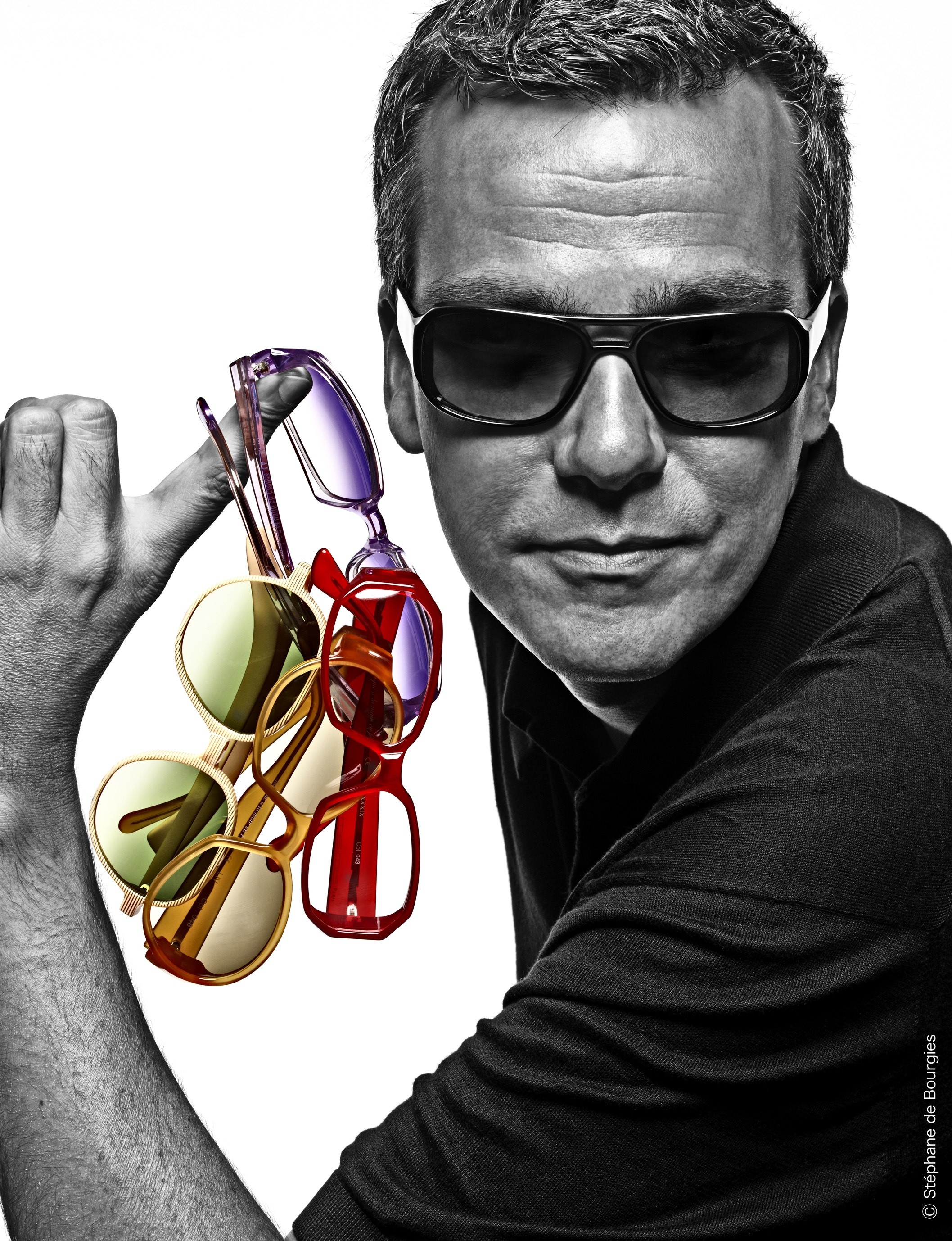
1st October 2011 Anthony Meima’s original design goal was to create jewellery. The eyewear industry and customers are fortunate that he changed his mind! Once Meima started optical studies, he became intrigued with the creation of frames. “I worked as a Product Manager for Beausoleil and Christian Lacroix, and became fascinated with acetate. Then I started to make my own designs by hand, and bought my own machine, which I had at home, then a second machine! I made prototypes for Chloë and frames for fashion shows.”
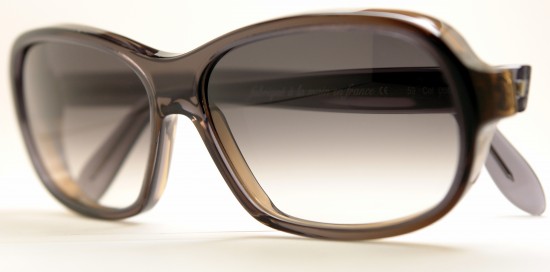
This is clearly a man who persists. And that persistence has paid off with his beautiful collections that are sold globally. As we chat in his charming little atelier in the 5th arrondissement of Paris, Meima expresses his passion for design and frames, and particularly his love of acetate. “Acetate is fabulous”, he enthuses, as he spreads a multitude of acetate colorations and gradations on the table, “and I really understand what goes into a pair of frames, and what makes quality frames expensive, because I made my own. The construction of my frames in particular, is quite special, because of the thickness that I like on the temples. What is sad is that it’s more and more difficult to find artisans to make frames like this, young people are not going into this trade.”
Meimas’s collections include ophthalmic and sunglass styles for men and women, with everything handmade in France. Certain styles have a thin strip of crystal in the design, giving the frame a luminous sheen and feeling of light. “I find inspiration everywhere, especially with travel, and people in the streets, or in the bus,” says Meima, “plus, the style and influence of the Bauhaus period is another inspiration. I don’t want to make crazy frames; I like classical shapes with a modern look.”
And this Meima has achieved with grace and elegance. www.meima.fr JG
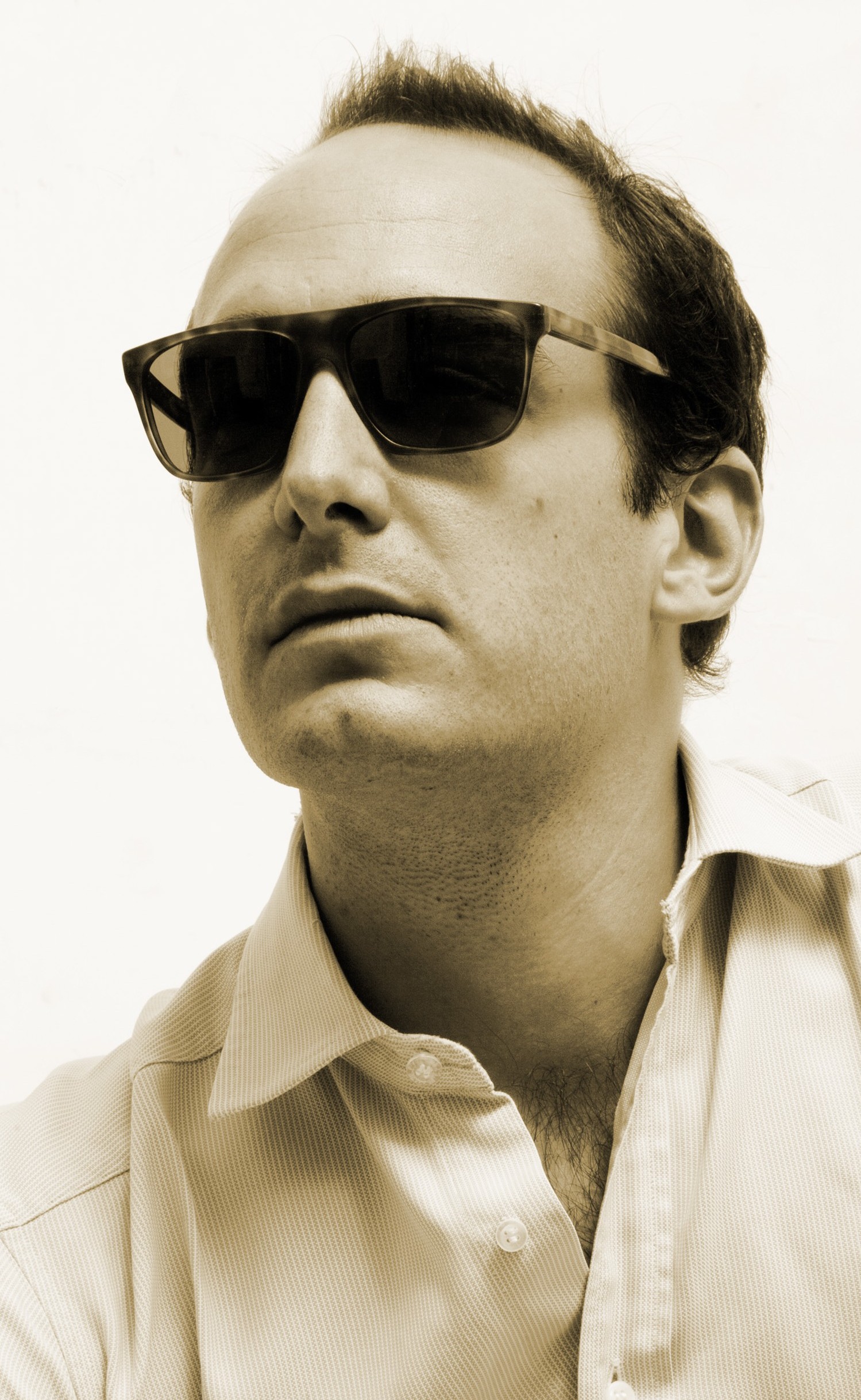
Luca Gnecchi Ruscone
L.G.R. Sunglasses
I spoke with Luca Gnecchi Ruscone over the summer by phone, and was immediately struck by his genuine enthusiasm for eyewear design, and fascination for the rediscovery of lost craftsmanship.
” In 2002, while I was accompanying by grandfather on a trip to Eritrea, I made a discovery which changed my life, and has brought me to this point with the brand L.G.R. which is really just at the beginning, we have so much more to tell.
My grandfather had lived in Eritrea for 40 years; he was a war photographer and after the war ended he decided to stay in Eritrea, and opened four photographic shop which became known as Foto Ottica Bini. He became a representative for Leika and other brands like Kodak. He then started importing frames and lenses, but not long after he became a shoe manufacturer for the local market. The shops became his second business. In 1974, with the revolution he had to leave and he lost everything. Quite amazingly, in 2000 the government called my grandfather to say that he would get some of his properties in Eritrea back, including one of the optical stores and the apartment above it.
I accompanied him on this trip back in 2002 – he was 92 and I was a graduate at the time. I stayed for one month in Asmara, a beautiful place with an incredible climate. I loved the atmosphere. I decided to drive around and visit the coast, but I needed some sunglasses…when I went downstairs in my grandfather’s shop and talked to my father’s colleague Bruno I looked in some closets and I found some incredible frames….and beautiful vintage lenses…Bruno fitted lenses in three pairs of sunglasses for me, and I was really impressed by how beautiful they were. At that point I decided to take 15 pairs back home to show friends and family and, as I was expecting, everybody was amazed that they were so wonderful.”

Months after this I was still getting emails from people asking for the sunglasses so I had more pairs sent over, and this allowed me to get the capital together to start my own business. By 2007 I started producing my own models. The first four models I produced were based on the original frames I had found in Eritrea…models Asmara, Keren, Massawa and Casablanca.”
Where do you produce your frames, how do you achieve true craftsmanship in the collections you are now designing, and quality that matches up to that of the frames you found in Africa? :”This is another beautiful side of what happened. I was running out of sunglasses, so I asked my grandfather how he thought I could create more with the same beautiful characteristics. He said go to Japan or China where you are living, and you will have them made cheaply and easily there. But I said no, these glasses have a history, they were made in the old way, how things were made in Italy before the economic boom in the 60s. Everything was made by an artisan and sold from the “bottega” in a very different way back then. So, I tracked down the address of the workshop near Prato where the frames were originally made and I just turned up there. An old lady opened the door, I explained who I was, and she said that her husband used to make the sunglasses, but that they had closed 20 years ago. Her husband showed me the warehouse where he used to make the frames, he had all the original machines and he explained the whole process to me. His eyes were shining it was very exciting and I couldn’t stop thinking about how we might get this working again. Now, just a few years on, we are producing the frames in Florence in this original workshop, and we have opened two other workshops including one in Naples.”
What will you launch for SILMO? “I am planning four new models of sunglasses and two new opticals. We are introducing two new colours of acetate which are very modern in a way, compared to what L.G.R. stands for, its classicism, its heritage. I want to show the market we are not just a vintage or retro brand. I want to show, and I have already given a first taste of this in our RAW LImited Edition which we presented three months ago, that we can achieve some modern and technical creations. We are introducing the polarised Neophan lenses, which offer incredible clarity – it’s a really unique eyewear experience. We are doing these lenses in a greenish blue called aquamarine and a vermillion.”
Does this mean you want to be an innovator in eyewear? “No, I want to bring back in some way what has been lost from the past, making no compromise with the price. I want to work towards offering the best quality lenses with the best quality frame at the right price. At the moment the brand is very exclusive as we have a very exclusive distribution, but this is just the beginning…. you have to start from the top and the rest will follow in time. I want to bring back what has been lost from the past to consumerism, we have cut away too many things and we have forgotten so much. I see this from my grandfather of how he speaks, how he eats, how he buys… and I respect so much these past attitudes in life. I want these aspects to be reflected in my glasses.” CN