Creative spirits

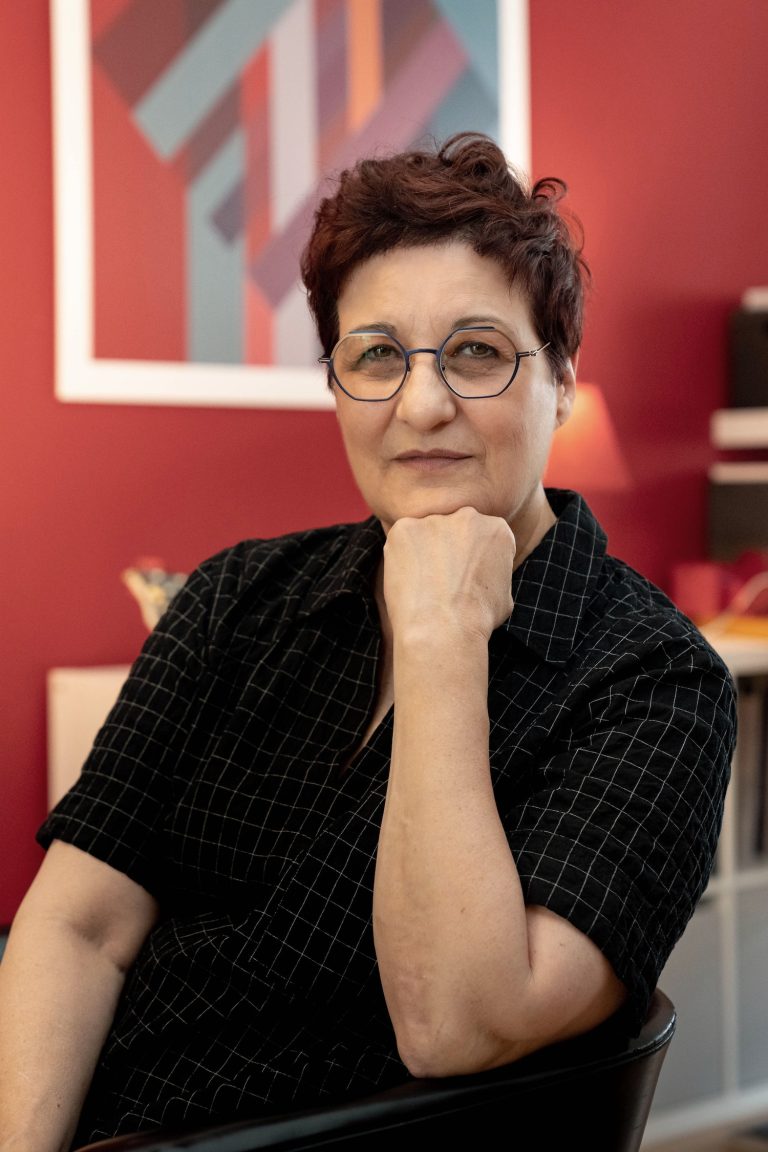
Laura Rattaro, freelance eyewear designer

Known particularly for her work on the Lamarca collections (from Tris Ottica), Laura Rattaro is a freelance eyewear designer with a wealth of experience in the optical business. She is fascinated by the connection between and perfect balance of shape and colour with special focus on ‘visual comfort’. We asked her to tell us about her career and her passion for eyewear design.

Laura, you have been working in the optical business for some time. Please tell us about your experience and how you started. I was born in Genoa into a family of opticians and optometrists, surrounded by glasses, lenses and pioneering ideas about progressive lenses from childhood. Spending time in the family shop and then studying optics gave me a wealth of knowledge that proved fundamental to my design work. I had a clear idea of my future right from the start: design was my primary interest and, having been born into the world of eyewear, I decided to specialise in this field. It is an interesting world in which design really means improving people’s lives and their visual well-being.

After participating in an internship in “frame design and prototyping” at the Centre Création Essilor in Paris, I officially started my career with small clients in Italy and then, a few years later, joined the big Rodenstock family in Munich as an external collaborator, but on an exclusive basis. I have been involved with the CERRUTI1881 collection since its inception.

It was my only experience working in a large company; after that, I focused on small and medium-sized companies with independent brands. I would mention VAVA eyewear, until 2021, which was one of the most interesting and stimulating projects of my career. I currently work as a designer for Lamarca Eyewear, a brand owned by Tris Ottica, for Emblema Eyewear by Aurigane, a company that invented prescription glasses for motorcyclists, offering unprecedented comfort under a helmet, and I am creative director for the Gambini1970 and Dandy’s brands owned by FaoFlex, all Italian companies. Above: Laura Rattaro, eyewear designer

Lamarca Eyewear – Fusioni Collection, inspired by art

You have a particular love for working in acetate. What is the draw for you of this classic material? Its beauty. No other material has a similar aesthetic appeal. The craftsmanship involved in part of the production process creates three-dimensional textures and gives it unrivalled depth. What’s more, its natural origin gives it a unique charm. I consider acetate to be a living material, like wood. I worked with it for years in my prototyping workshop and have retained its tactile memory in my mind. Fantastic. And then there’s the colour! Its different textures, transparent, translucent and solid. It’s inspiring.

How do you see the relationship between shape and colour in a frame, and what else do you perceive to be fundamental to the quality of a frame, other than the fine quality of the materials? Shape and colour are absolutely linked. There are shapes that can only be coloured in certain ways and, conversely, there are colours that are suitable for some shapes and not others. Colour is a language that is just as important as form.

Quality is a combination of factors that go beyond materials. Design quality is fundamental: good design requires attention to facial ergonomics, comfort, weight distribution, correct curvature, it’s complex.

Among the collections you are designing in 2025 is Lamarca and the elegant series – MOSAICO and FUSIONI. Could you tell us about the inspiration for these two lines and what gives both such a unique aesthetic and identity? Mosaico is a Lamarca family that speaks of colour. In 2025, this will express lightness, bright but not “loud” colours, original but not exaggerated shapes (visual comfort first and foremost) and reduced volumes, thin circles.
Fusioni is inspired by art. In particular, in 2025, there are futuristic notes, inspired by Depero, the Italian painter/writer. I was interested in expressing colour and design in a very graphic way. Solid colours, bold contrasts, clear lines.

What are you currently working on? The collections for 2026 are already in production for all my clients. We will see what the market thinks at Mido. I don’t want to give anything away, but I can say that I am always looking for original formal and chromatic languages.

As a designer, do you feel that fashion trends are still relevant to eyewear directions? What other influences and inspiration are important today? I have never followed fashion to do my job. Of course, there are general guidelines imposed by the market, but I have always tried to add an original touch to the product. It is eyewear for designer labels that is forced to do so, but not independent brands. They are really two very different worlds. In the first, eyewear is an accessory, while in the second, the products are the protagonists.
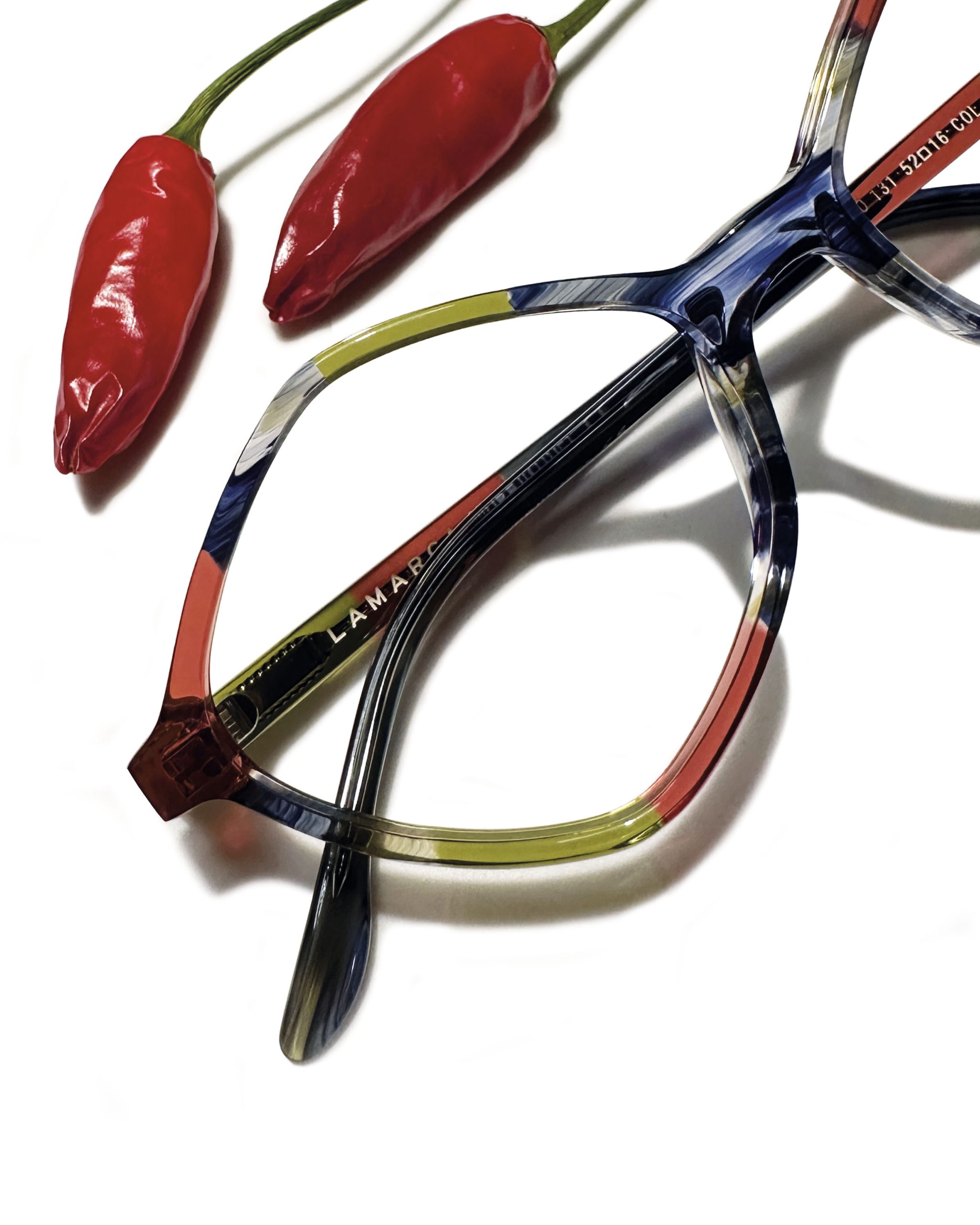
Mosaico – 131-06 by Lamarca Eyewear

Macro trends should be observed carefully, as they tell us about the future through general aspects of people’s lives and, more generally, are influenced by what is happening in the world. We have terrible wars close to us that influence people’s thoughts, their perception of reality, their desires, their vision of the future… all of which can determine the direction of design, especially the colour of products.

How has technology changed the way you work in the last years, and are you inspired by the ever changing possibilities for innovation that new technologies bring to design? Technology = speed. For everything else, human sensitivity, imagination and craftsmanship still matter: those who have never worked with their hands will find it difficult to make the most of technology, from 3D printing to AI, without distinction.

What’s your next project for 2026? I would like to travel beyond the borders of Europe. There are new inspirations out there, colours and cultures for me to explore. As far as collections are concerned, 2026 is already history for me. I look forward to 2027 with positivity and the enthusiasm needed to always do the best I can.

For more information about Laura Rattaro please visit https://laurarattaro.com/
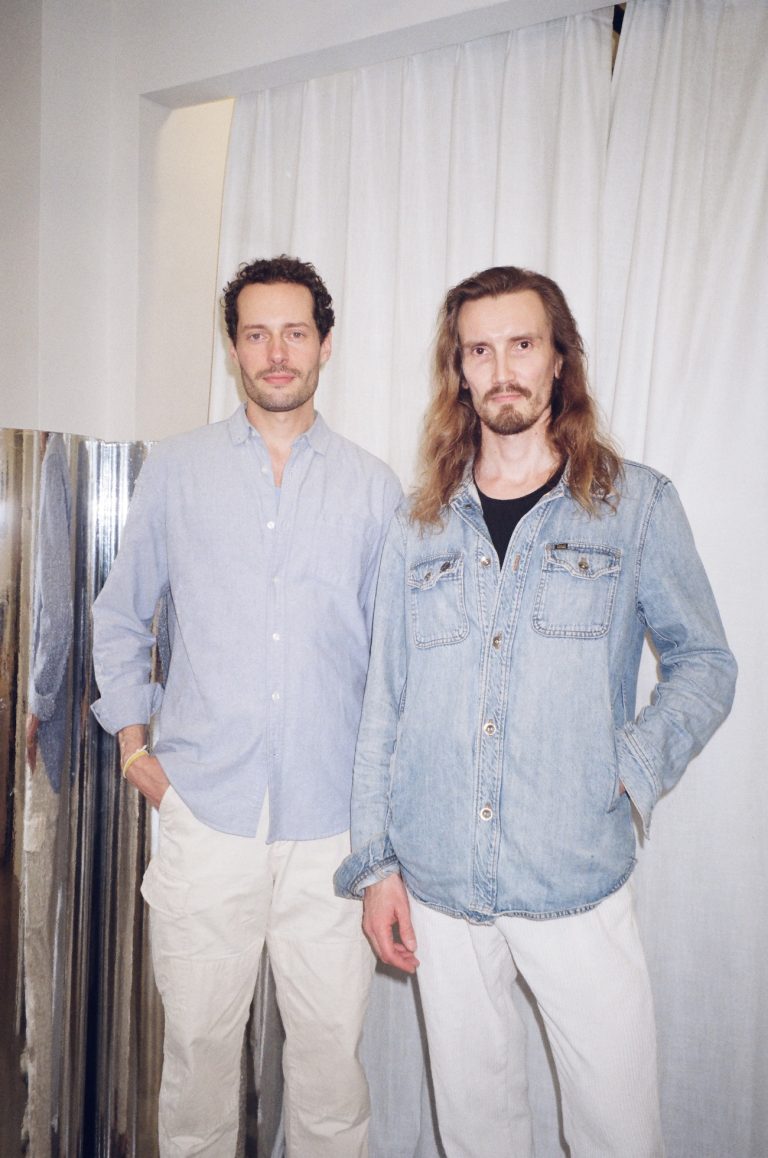
Alexis Perron-Corriveau and Mika Matikainen, Founders, Paloceras

The emerging eyewear house, Paloceras is quietly establishing itself on the global fashion map. This month, the brand marks a significant milestone with a launch in New York, unveiling two new silhouettes in its acclaimed Pebble collection, alongside a striking palette of new colours and combinations across the entire range. Eyestylist spoke with founders Mika Matikainen and Alexis Perron-Corriveau about their creative partnership, the brand’s origins, and the pursuit of innovation that drives their distinctive take on eyewear design.

What were you working on before starting Paloceras? Alexis: I grew up in Montreal and began my career as a woodworker, creating bespoke furniture and architectural pieces. That hands-on experience led me to pursue product design at university in Montreal. After working locally, I felt the need to look beyond Canada and applied to ECAL in Lausanne to study in the Master’s program in Design for Luxury & Craftsmanship. That’s where I met Mika. We both completed the program, and from there, Paloceras began to take shape.

Mika: My background is in digital design. I had been working as an art director at an advertising agency in Finland, and later with tech companies, mostly in digital product design. After years of working in digital environments, I started longing for something more physical. While living in London during a COVID lockdown, I took a walk with a designer friend and we spoke possible futures and a Swiss design school ECAL came up. I applied, was accepted, and that decision shifted everything. Alexis and I met there. I was coming from digital, seeking tactility, while he was coming from craft, interested in digital. Our skills were complementary, and we felt it made sense to try something together, though we had no fixed idea of what that would be. Toward the end of the programme, Alexis began exploring sunglasses in his thesis. We started prototyping and eventually committed to making eyewear. We had no idea how complex the field would turn out to be.  Above: Alexis Perron-Corriveau, Design Director (left) and Mika Matikainen, Creative Director (right), Paloceras – photo by Anderson Martinez

Paloceras: from the Pebble Collection, Pistachio Green SX

How did you come up with the name Paloceras and begin to build the brand? Mika: Once we decided to do something together, we needed a name. I was still living in Switzerland at the time and one day, while walking through a park, I saw butterflies. I started thinking about the Latin word for butterfly, Rhopalocera. I removed the “Rho,” added an “s,” and checked availability. To our surprise, everything was free – domains, handles, all of it. I called Alexis immediately.

Alexis: We met at a small African café in Lausanne and decided that was it. We registered the name right there. That was even before we had thought of the Pebble collection.

How long did it take to develop the inflated acetate aesthetic, and where are the frames made? Alexis: It was a long journey. We set out to make something that felt unfamiliar in a category where most designs seemed too similar. While we are not claiming to reinvent eyewear, we wanted to create shapes that would be immediately recognisable as Paloceras. We experimented with acetate and used physics software and digital tools to explore unconventional forms. That led us to inflated shapes.

We reached out to manufacturers in Italy and France, both close to our base in Portugal, but the technology to produce the shapes we wanted was not available. Eventually, I travelled to Shenzhen, where we found a small, highly skilled team with the right capabilities. Their process uses a moulded approach closer to injection moulding, specifically adapted for acetate. At the time, this technique wasn’t available in Europe, and even now, it’s far from common. The real expertise still lives in Shenzhen, so we had to go straight to the source.

Is there a level of innovation in the production techniques themselves? Alexis: Absolutely. The moulding process requires different machinery and skills compared to traditional acetate manufacturing. This combination of design intent and technical execution is what allows us to push boundaries. I have visited the team in Shenzhen several times. It was important for us to see the production first-hand, to understand the working conditions and ensure they met our standards. We are transparent about our partnership there because the work is excellent and the collaboration is strong.

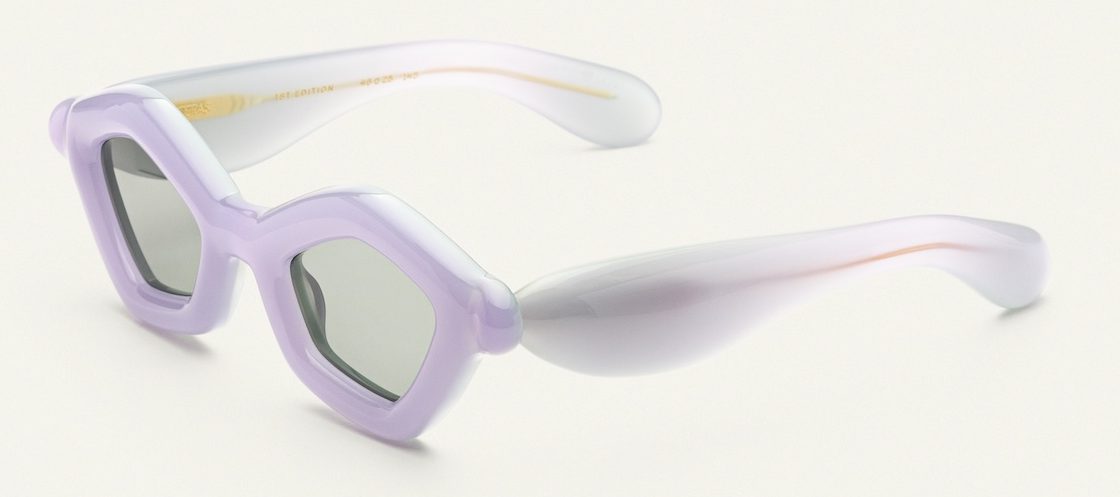
Paloceras: Pebble collection – Lilac Dream SX

The Pebble collection quickly gained attention in fashion circles. Was that the goal from the beginning? Mika: We wanted to approach eyewear as a functional object with emotional and aesthetic impact. The category often views itself through a technical or optical lens. We wanted to see what would happen if we looked at it through fashion.

Alexis: It began as a creative experiment, but always with the ambition to connect with people. My Master’s thesis focused on sunglasses and their cultural significance. What I realised was that the eyewear world is full of gatekeepers. There are few independents, and it is a difficult industry to break into. That challenge pushed us further.

Mika: I have always been interested in the point where design, technology and business meet. For me, staying in one of those domains would not have been enough. With eyewear, it was not just about designing something new. It was about building something with a broader creative ecosystem. We now collaborate with artists, especially through our London atelier, where we craft bespoke designs. These partnerships allow other creative visions to exist within Paloceras, which makes the brand more than a product, so it becomes a platform.

Bespoke eyewear created with Pauline Pierre / London atelier

You recently introduced two new shapes: VX Aviator and DX Diamond. What led to these designs? Mika: The collection started with one square and one round shape. That was never going to be enough. Aviators and cat-eyes are popular, but we wanted to reimagine them through our own language.

Alexis: There is a delicate balance between making a sculpture and making something wearable. That tension drives us. The Aviator is bold and recognisable. The Diamond has an angular, edgier character. It nods to the cat-eye but is more neutral. We want our pieces to be for everyone, so we avoided a fully feminine silhouette. These new shapes also respond to what people have been asking for – more variety, new forms, and more colour.

Mika: Colour has been a big part of our evolution this year. Beyond classics like black and tortoise, we are introducing dual laminations and full tones based on our own experiments. Some are made using Mazzucchelli’s custom laminates, others we developed ourselves by combining different magnetic colours. It is a big leap forward for the Pebble collection.

You are based between Portugal and Finland. How does that structure work for you? Mika: Most of our team is in Finland now. Alexis is still based in Lisbon, where we do the biggest part of our prototyping and have the design studio.

Alexis: Portugal was the original home of the brand. For the first year, everything was developed there digitally. When Mika returned to Finland for family reasons, we adapted and found a rhythm that works for us both.

Paloceras, Pebble Collection – Enchanted Sage DX

What are you working on next?  Mika: We are preparing to unveil our first optical collection.

Alexis: Development is already under way. We plan to present the collection in September at Silmo in Paris. Having an optical line is important for our retail partners. These new pieces are designed for everyday wear, while keeping the same creative ethos as our sunglasses.

Paloceras sunglasses are available at Paloceras.com and select opticians worldwide, including Black Optical, Atelier Mira, Gogosha Optique, I Visionari and Framed Ewe. The brand will be present at Silmo Paris in September 2025. Find out more about the collection at the Eyestylist link here https://www.eyestylist.com/2025/05/paloceras-pebble-collection-ss25/ and visit www.paloceras.com

Interview by Clodagh Norton. All rights reserved.

Linda Farrow: Simon Jablon on luxury eyewear and a special appearance at Mido ’25

In an exclusive interview and an all time first on Eyestylist, Linda Farrow’s son, Simon talks about the UK brand and its heritage as well as announcing a very special guest appearance for the MIDO event 2025: his mother will be at the show to meet visitors as the brand launches the Iconic collection, a stunning design collection with a campaign featuring Linda Farrow as the model.

LINDA FARROW has an incredible history dating back to 1970, when your mother first created the brand. How have you built upon that extraordinary legacy since you reintroduced the brand in 2003? My mother redefined the eyewear industry elevating sunglasses and optical glasses into a statement accessory. She challenged conventions and pushed creative boundaries with her designs. Upon relaunching the brand in 2003, we were able to revitalise the eyewear market by steering away from the generic designs we saw everywhere else by re-introducing some of her more unique vintage pieces. As the company has grown and we continue to introduce trend lend designs we are very careful to stay true to the brands original DNA – timeless elegance with a modern twist. Today we honour her legacy by combining bold innovation with a commitment to enduring sophistication and high quality. Above: Linda Farrow and Simon Jablon – Linda Farrow stars in the new campaign for the Iconic collection

From left to right: Julian Jablon, Linda Farrow and Simon Jablon as a young boy

What do you remember most about your mother’s passion for eyewear design when you were younger, and – during her career – was she an entrepreneurial creative as well as artist/designer? My mother was a visionary designer who saw eyewear not just as a practical necessity, but as a creative canvas, and pioneered the concept of designer sunglasses long before it became an industry standard. Her passion wasn’t just about creating beautiful frames, but about making them a bold form of personal expression that challenged traditional design conventions. She understood the intersection of fashion, art and functionality long before it became a mainstream concept. Her designs were not just about aesthetic appeal but about creating pieces that told a story, that made the wearer feel inspired and empowered. She was both an artist and a business woman who understood how to turn her creative vision into a ground-breaking brand that stood the test of time.

Archive picture of Linda Farrow working  in her studio

What was the biggest challenge in re-building the brand in 2003, and how have things over the years from your personal perspective, I’m sure there have been some challenges as well as good times? We had to reposition ourselves in a competitive and overly commercialised market, demonstrating that we were more than just another eyewear label, but a design-driven brand with a rich heritage of innovation. As the brand evolved, we encountered challenges in maintaining our design integrity while adapting to changing consumer preferences. The most critical aspect of our rebuild was preserving my mother’s original vision of innovative, boundary-pushing design while creating a sustainable, modern fashion brand.

Linda Farrow continues to be singled out as an example of a highly successful family-owned independent eyewear label…with a global following. How much do you value “independence” in the current climate and in an optical world which is dominated by massive players and mass production? Our independence allows us complete creative freedom. Our design philosophy is to actively challenge conventional and mass-market eyewear designs through bold experimentation and risk taking. Our commitment to innovation is exemplified by working with unusual material such as buffalo horn, sterling silver or palladium, each carefully selected to push the aesthetic and technical boundaries of luxury eyewear.

With so much focus on craftsmanship and artisan techniques – and particularly Japanese expertise, what for you are the really exciting developments achieved in your collections in the last few years? Mention any particular steps you have taken in terms of adding to the already luxurious quality and innovation-led design work found across the Linda Farrow collections…we know much thought and passion goes into developing product at this high level? Renowned in the industry for their meticulous precision and exceptional technical expertise, we can guarantee unparalleled luxury and craftsmanship in all our Japanese hand-crafted frames. As we ensure to prioritise quality, all LINDA FARROW’s frames are precisely cut, finely polished and assembled, hence why our lead time is longer.

Surrealist collection – Autumn/Winter 2025

Collaborations have been a fascinating part of the LINDA FARROW story, and you have worked with some spectacular fashion designers. What have been highlights for you in your wonderful collaborative design collections and do you enjoy working with brands and exploring new synergies? Our collaborations have been instrumental in expanding our creative horizons. We focused on strategic collaborations with design powerhouses such as Dries Van Noten, Magda Butrym or The Attico, which helped us reconnect with fashion-forward consumers and introducing LINDA FARROW to new global audiences, while maintaining our distinctive identity. Our recent license deal with Jacquemus represents a particularly exciting milestone. Seeing our sunglasses featured prominently in their fashion shows and adorned by celebrities has been a remarkable validation of our collaboration approach.

What will you launch at MIDO this week and what do you look forward to most about this international show? We look forward to showcasing our new Surrealist AW25 collection as the reaction so far from the previews has been fantastic. The main thing is that Linda Farrow herself will be joining us at the show, her first time returning after many years. This event represents a unique opportunity for some of our favourite clients to meet and greet my mother directly, the pioneering visionary behind the brand. This will coincide with the launch of the Iconic collection for which she is featured as the model. For more information visit www.lindafarrow.com – an exclusive interview by Clodagh Norton for www.eyestylist.com. All images were kindly provided by LINDA FARROW.

Carola Nomden on joining Ørgreen Optics

Carola Nomden is an eyewear designer with a wealth of experience in the optical field, previously working at SAFILO and Prada. She is known for her creative expertise and modern, cosmopolitan aesthetic, particularly in sunglasses. Carola has joined Ørgreen as the Danish company brings together a creative team to rival many of Europe’s finest. Eyestylist asked her to share her perspective on her work and creative passion.

How and where did you train to become a designer? How did you get into eyewear? Can you tell us in a few lines about yourself? My journey as a designer began at the IED in Turin, where I studied jewelry and accessory design, diving into a world of precious materials, craftsmanship, and innovation. I’ve always been fascinated by the idea of creating objects that not only adorn but also tell a story and reflect the personality of those who wear them. This philosophy naturally led me to eyewear, a field I see as the perfect bridge between functionality and pure creative expression. For me, every project is a journey through details, shapes, and symbols, with the goal of transforming the everyday into something extraordinary.

What have been the high points of your career so far? One of the most significant moments in my career was having the opportunity to closely observe the work of great creative minds, an experience that deeply inspired and enriched me. It taught me the value of bold and refined thinking, which I strive to bring into my work every day. Above: eyewear designer, Carola Nomden

Tribune acetate glasses by Ørgreen Optics

What do you feel are the most interesting processes as regards designing frames, and do you have a particular style or influence that is typical of your work? For me, the design process is a true form of alchemy. The beauty of design lies in seeing something that was initially just an idea take shape and come to life. I love exploring the endless possibilities of materials, like a craftsman who molds forms and colours, bringing new universes to life. Each project is a moment of discovery, where the idea transforms and takes root in reality. Working with volumes allows me to define essential lines, but my true goal is to give each creation a sense of modernity, while never losing sight of the elegance and purity that make it distinctive.

As part of the Ørgreen team, what are your favourite new challenges? One of the most exciting aspects of being part of Ørgreen is the diversity of backgrounds within the team. Each of us brings a unique perspective, shaped not only by our countries of origin but also by our individual professional experiences. This diversity is a tremendous strength, as it allows us to tackle design challenges from different angles and develop creative solutions that we might not have considered otherwise. It’s this exchange of ideas that makes working with Ørgreen so inspiring.

Sheriff by Ørgreen Optics

When you are not working, what do you like to do and what interests you in the creative field? When I’m not working, I like to immerse myself in what stimulates my creativity: reading books, exploring illustrations, graphics, cinematography, and art. Every form of visual and narrative expression helps me see the world from different angles, enriching my creative language. I am also fascinated by the human being, by their expressions and the small everyday details, which often become inspirations for my design, making it closer and more in tune with people.

Do you take interest in the evolution of eyewear, new materials and sustainable trends, and if so what do you imagine will be a particularly significant direction for the business in the next 5 to 10 years? The eyewear industry is in constant transformation, and I am fascinated by how technology and sustainability are intertwining to create increasingly innovative solutions. In the next 5-10 years, I envision a significant evolution in the use of biodegradable and recycled materials, with a growing focus on lightness and durability, without ever compromising design. I also believe that, alongside this, consumer awareness will change, driving them to seek brands that prioritize the health of the planet.

Inner Circle by Ørgreen Optics

What is on your mood board this week? My mood board for 2025 explores the meeting between craftsmanship and technology, a return to the roots of human experience fused with the discoveries of the future. Natural, earthy tones are enlivened with vibrant accents, while volumes intertwine in elegant and bold shapes, creating the perfect balance between tradition and innovation.

Finally, could you add any other points of interest about your work as a designer? When I design, I am deeply influenced by the intersection of culture, nature, and personal expression. To me, eyewear is not just a functional accessory, but a way to tell stories and celebrate individuality. My creative approach is rooted in my hometown, Turin, a city where every corner tells a story and where architecture and art continuously engage in a dialogue between the past and the future. Now that I live in Copenhagen, I find myself in a new creative phase, one that is shaping my work in unexpected ways, bringing fresh perspectives and ideas into my designs.

Find out more about design at Ørgreen Optics at www.orgreenoptics.com

Vidal Erkohen, eyewear designer + founder of RVS

Vidal Erkohen is the founder of RVS Eyewear, as well as working as an eyewear designer behind multiple independent brands. His most recently launched collection is a sports eyewear line for Perfect Game, the world’s largest baseball scouting organization. In 2025, Erkohen plans to bring RVS back into the eyewear spotlight with a brand new collection….

It’s a long time since we caught up here on Eyestylist.com. Do you continue to evolve the RVS by V collection from your base in New York City? It truly has and it’s great to be back. Eyestylist has continued to be a leader in the industry and we are all lucky to have such an informative outlet for independent and main stream eyewear. Thank you!
Although I have been very busy with designing, manufacturing and providing creative direction for multiple brands through out the years RVS has always been at the core of everything I do. Since 2020, I decided to pause on new designs and have only been supplying a handful of our classics directly to our loyal consumers worldwide.
That being said, I’m happy to finally break the silence and inform you that RVS by V will be back in full swing starting in 2025 with a fresh new vibrant collection and will also be available for wholesale purchase worldwide via a select few of our most loyal partners through out the years. If you followed us before I’m sure you know that whatever is coming, it definitely will not be boring! 😎  Above: Vidal Erkohen – pictured wearing “See a clean future” Water sunglasses in collaboration with Mission Blue (Sylvia Earle)
Iconic styles by RVS Eyewear – the brand launched in 2007 at Selima Optique – originally as a 25 piece collection
The last few years have seen some developments in the industry as regards sustainability. How have you pivoted in this direction?
Could you explain the See A Clear Future concept and RVS SUSTAIN. What is your view on eyewear materials and how they are evolving? The developments prior and since have been tremendous and it’s a breath of fresh air to see more and more designers and manufacturers moving their materials and production towards more eco-friendly solutions.
I think this is just the beginning and we will continue to see very clever solutions that minimize our carbon foot print in everything we create. As RVS, we learned a lot through our “See a clean future” project and aim to incorporate this in all of our future projects as well.
See a Clean Future – a sustainable eyewear project developed by Erkohen
See A Clean Future incorporates four different lens options which correspond to the elements that make up our world: Earth, Water, Fire, and Air. They tell a story of ECO-HOPE by linking each concept with a hero from our time: Sylvia Earle (Water), Jane Goodall (Earth), Wangari Maathai (Air), and E. O. Wilson (Fire). Each of the aforementioned have provided inspirational words that correspond to the assigned element, which are inscribed on both the inside of the sunglass frames and the lens cloths. Using natural materials.
The frames are produced in innovative materials from the renowned Italian Mazzucchelli company using their M49 bio-plastic, which is eco-friendly, recyclable, and biodegradable. The bioplastic is produced from cotton linters and wood fibers, which are purified into a pulp and then transformed into a resin known as M49.

All the metal inlays as well as temple hinges are made of stainless steel—a recyclable product. The steel is coated with ion plating, which protects the surface and allows the engraving of the frames. Ion plating is a physical vapor deposition process that uses concurrent or periodic bombardment of the substrate with aluminum, which is recyclable and non-toxic to the environment.

The sunglass lenses revert to the traditional use of glass. Typically, lenses are made from polycarbonate plastic but See A Clean Future lenses are made from natural mineral glass produced in Japan. Glass lenses are not only more environmentally sustainable, but also ensure precision clarity and a more refined aesthetic, which is harder to achieve with traditional plastic lenses.

See a Clean Future – installation by Ugo Rondinone
3. We noticed you are working with the artist Ugo Rondinone for your packaging. How did this collaboration come about? Yes, this was a truly amazing experience as Ugo was a friend of the art initiative  “One, all, every” that we partnered up with for this project.
Using natural materials, Rondinone designed the packaging, the ether, or fifth element that contains all others (air, water, earth & fire).
When we launched the project at Art Basel Switzerland as well as later in Miami, our booth was made of 15 feet tall walls covered in real soil taken from his native town in Switzerland.
These walls were later cut in to 10 x 10 individual pieces and sold as limited edition artworks along with all 4 sunglasses all signed by Ugo with a portion of the proceeds given to each respective environmentalist organization.
It was a real labour of love and an unforgettable experience working with such tremendous minds.
Perfect Game Eyewear – a recent project
4. Do you continue to work as a Creative Director for other eyewear brands and what is your favourite project of 2024?
Yes, and to be honest this has taken a big chunk of my time for the last few years hence my absence from RVS. It’s been a treat to work with other creatives while sharing my experience in the industry and building new brands from the ground up. My latest project, Perfect Game Eyewear is a brand new field for me (sports eyewear) which has been extremely exciting.
Perfect Game is the world’s largest baseball scouting organization holding over 5000 events nationwide year long while working closely with the MLB.
To date, more then 2034 players that have played in perfect game events have also played in Major League Baseball. Since 2003, 14,466 perfect game alumni have been selected in the MLB first year amateur player draft.
Following PG’s exclusive deal with Oakley coming to an end we were able to secure a 10 year licensing deal with Perfect Game via our licensing company PROformance Eyewear and will be designing, distributing and manufacturing all PG Eyewear sunglasses moving forward.
Our proprietary “Diamond lens technology” which I created after almost 2 years of research and development is the first of its kind to focus solely on the game of baseball to enhance game play for both pitchers and batters alike. This is just the beginning as we are planning a huge expansion for this brand in terms of technology, design and reach.
5. What are you working on for 2025?  Along with the relaunch of RVS which I am most excited for, I am currently also working on a new brand (also my own) which although I can not give to much information about will bring a fresh new concept to the industry. I always like to go the exact opposite direction of where everyone else is going. This will be no different.
Vintage eyewear is one of Vidal’s passions: pictured, a very early pre Persol Ratti 714 folding style (1930’s). “Most likely a very early prototype to the 714 that would be introduced many years later. Simply signed “Ratti” with the old school Pelican logo”
6. Are you still a passionate collector of vintage eyewear and do you have a favourite design which you acquired recently. Do you still study vintage eyewear as part of your inspiration?
My passion for vintage eyewear is really what got me started in the industry and restoring vintage frames is how I got to know the ins and the outs of eyewear production itself. I still spend at least an hour of my day doing research on frames of the past with my expertise now focusing on materials that are seldomly used such as genuine tortoiseshell, solid gold, unusual hinge technologies and more! I’m a sucker for nostalgia and manufacturing of the past still hold a big space in my design inspiration. Of course, I’m still a Persol fanatic as at one time I owned one of the largest private Persol (Ratti) collections in the world. It’s the only brand my father used to wear and it always holds a sweet spot in my heart.Good design never goes out of style.