Eyestylist

| Eyestylist 4th November 2020

Sustainable creator: Cristiano Ferilli

Cristiano Ferilli is a qualified ophthalmologist by day and a designer by night. If that alone doesn’t strike you as an accomplishment, Cristiano founded Ferilli Eyewear; the first eyewear brand to use cactus fibre – Sikalindi – in the manufacture of their Italian-made frames.

Cristiano, you speak of falling in love with the world of eyewear at the age of sixteen – forgive me if this is a backwards notion, but it’s perhaps quite an unusual attraction for a young boy to develop at such an age – how did this passion first ignite? When you’re a 16-year-old boy, I believe that you normally have a secret wish in life – it’s up to you to truly believe in that wish and make it come true. I think what pushed me back then was attending the Mido 2010 trade show and seeing so many sunglasses made with different kinds of materials. I said to myself then that when I was older, I would discover my own material to create my sunglasses.

Would you be able to tell us a little about your career path, did you always envision yourself working within the fashion industry? No, not at all. After getting an optician’s diploma at high school, I graduated with a degree in Orthoptic and Ophthalmologic Assistance, continuing that career path in clinics and hospitals. However, right after university I made my first sunglasses collection; I believed in it so passionately that Ferilli Eyewear has become my job today. While I’m busy with work as an orthoptist in a clinic, I’m also committed to creative projects as a designer for my brand.

Ferilli Eyewear: a sustainable collection using prickly pear fibre

How is it that your brand Ferilli goes beyond the concept of ‘just an accessory’? Prickly pear fibre creates a very particular pattern on every frame. I like to think that they are not just sunglasses, but they can be considered a fully-fledged design element that add a unique touch to a look, and that they are a distinctive feature that help define the wearer’s personality. Moreover, I care about the functionality of my sunglasses, not only about their design, and this applies also to the choice of lens.

Being the only brand of eyewear that uses Sikalindi is an amazing claim to be able to make, especially in an industry where the consumer is growing more aware of the impact of their purchases, and many brands are trying to find the newest, most innovative way to forge a sustainable future – tell us a bit more about producing frames with Sikalindi? In the region where I live – Puglia, in southern Italy – prickly pears are fast-growing plants, and sometimes there are so many of them that entire areas need to be cut down and thinned out. To obtain the fibre itself, we dehydrate the leaves of the plants through various physical processes – but without using chemical agents or pollutants. In this way we can extract the material we need, while respecting the environment and the natural cycle of the plant.
Ferilli Eyewear: the frames display the patterns of the natural fibre

I assume you subscribe to the idea that the consumer needs to  ‘buy smart’ and ‘buy less’ in order for our planet and resources to survive? Why should the consumer invest in a pair of Ferilli sunglasses, in your opinion? Our products guarantee functionality from a technical point of view and they are made with a unique, sustainable material. Our aim is to be creative and innovative producing naturally beautiful sunglasses that respect the environment.

Finally, your website says that you hope to develop some new ‘sparkling ideas’ in the future – is there anything on the horizon? I can tell you that the prickly pear fibre will be incorporated into other materials, and we are meticulously studying new models that will amaze you!

To find out more about Ferilli visit www.ferillieyewear.com. Interview by Victoria G. L. Brunton exclusively for Eyestylist.com
 

| Eyestylist 3rd November 2020

Winter Sun with Oliver Goldsmith Sunglasses

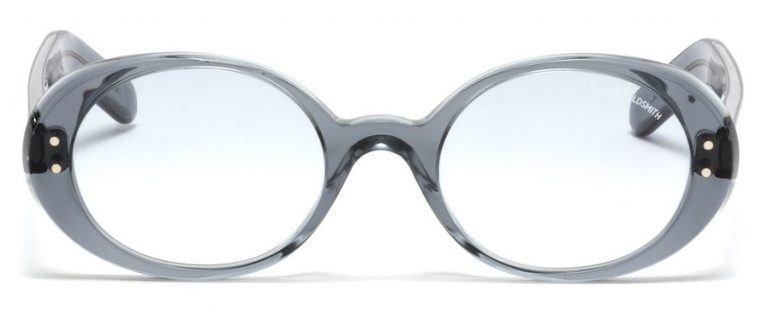
Millinaire, an original shape from the OG archive, first launched in 1968

In 1968, when Millinaire was first launched designer Oliver Goldsmith was already dressing the stars and providing innovative statement eyewear for men and women with a taste for fashion and unique attention-grabbing style. They were appearing on magazine covers, were worn by the likes of Grace Kelly, Peter Sellers and Michael Caine, and famously popped up in movies such as Breakfast at Tiffany’s (on Audrey Hepburn in 1961).

Millinaire in classic black – the frame is also available in lilac or “anchor” grey

Today the Millinaire model has returned – reintroduced into the Icons Collection at OG as part of the brand’s unique Winter Sun edition for 2020/21.  The small oval shape – typical of the 1960s – is one of the classic shapes that remains integral to the evolution of the brand and its exciting history. The fine handcrafted detailing and design features such as the thick and elegant acetate temples and small subtle metal pins, on front and sides, are carefully reproduced as they were in their original form – and paired with state-of-the-art modern Zeiss sun lenses with especially light tints –  to suit the winter sun.

The original Millinaire model from 1968 is one of over 70 pairs of glasses and sunglasses held at the V&A Museum in London – find out more at https://www.vam.ac.uk/articles/the-oliver-goldsmith-glasses-collection#slideshow=61993239512&slide=0 – To view the new Millinaire online visit https://www.olivergoldsmith.com/product/millinaire-ws/


| Eyestylist 31st October 2020

RES/REI: The Essences Collection

Like a perfume, created by mixing and matching beautiful scents, the Essences collection is conceived through the balancing of transparencies and hundreds of unique colour compositions

New release: The Essences collection by Italian eyewear creators RES/REI is inspired by the magical world of perfume – with a delicate spirit and careful study of light effects with an interplay of colour. Just as fragrances are created by blending different ingredients, the eyewear in the Essences collection is the result of a careful equilibrium of design details and the balance and contrasts created through transparency and vibrant colours. Above: model Anise in dark havana, purple, green and shiny silver.

Almond by RES/REI in grey havana, red and green

With delicate shapes, embellished with metal temples in light shades, the styles – such as model Almond have complex bi- and tri- colour combinations which, when seen on the wearer appear to have a coloured line floating on the face, framing the eyes.

Model Amber by RES/REI in dark havana, purple, green with shiny silver temples

RES/REI’s philosophy puts design, colour and attention to details at the centre of its creative direction requiring a deep and focused approach to research and innovation, to provide contemporary spectacles with a consistently surprising and artistic style and individuality. This season, the brand, whose collections are made by skilled artisans in Northern Italy has launched several new lines in addition to The Essences collection. They include the Diamonds Collection and The Galaxies Collection. Find out more about RES/REI at www.resrei.com

| Eyestylist 30th October 2020

Something for the weekend: theo

theo Lavalands “hot vs. cold” – geologic-inspired designs, in daring colours

Inspired by the raw encounters of the forces of nature – hot lava and cool seawater – and the creation of unique volcanic islands, a new series by theo pushes the boundaries of eyewear creativity for the new season – as we’d expect – with stark contrasts in materials and powerful somewhat awe-inspiring colour choices. The five frames – named after well-known volcanic islands – Santorini (Italy), Maui (Hawaii), Flores (Indonesia), Karukera (Guadeloupe) and Aogashima (Japan) combine warm acetate and cool steel, with contrasting angles, smooth surfaces and strong, exhilarating shapes – all in their own way daring, idiosyncratic and spectacularly dramatic. Above: model Karukera by theo in the Lavalands collection – an iconic round shape in the series.

Model Aogashima by theo © 2020 copyright protected Artworks,
Photography & Graphic Design!

Each model is available in eight contrasting colours and materials, with highlights including fiery tones of yellow and orange and signature theo colours of bright blue, cool “ash” grey and hot pink. The line is one of three new collections themed under the motto “theo goes upstream” – promising an injection of absolute uniqueness and personal style – in pure design that goes far beyond its functional purpose. Access more visuals and further details on Lavalands at theo’s website – www.theo.be

| Eyestylist 27th October 2020

Mykita Lite: essentials for the season

Mykita’s edit in the Lite collection for autumn/winter points to timeless qualities in classic eyewear shapes and essential technical precision to create frames that are easy-to-wear while imbued with a stylish spirit for today. The models are strong yet understated, and come in predominantly natural tones, to complete the autumn wardrobe, metallics and neutrals such as dark brown, mocca and raw green for lenses. Above: Mykita Lite Jul – a lightweight stainless steel frame with slender acetate details – image from the 2020 campaign shot by Mark Borthwick for Mykita.

Paulson from the Mykita Lite collection, combining stainless steel + acetate

The classic panto shape model Paulson is offered both as an ophthalmic frame or sunglass style. For sunglasses, the tinted lenses of the Lite collection have anti-reflective coatings on the reverse side and total protection from UVA and UVB rays as well as protection from glare.

Flemming in the Mykita Lite collection – pictured in glossy gold

Round shape Flemming is a wonderful balance of comfort and lightness, with a simple construction and fine lines, and it comes in metallics such as gold or silver as well as black or navy. The frame is one of those classic designs that reflects an iconic look of the past in a union with modern manufacturing. Mykita Lite frames are defined by their smooth contemporary silhouettes and pure constructions and are made exclusively in Berlin, Germany at the Mykita Haus (Kreuzberg).  Find out more at www.mykita.com