Arts + travel

Celebrating photographer Bill Cunningham

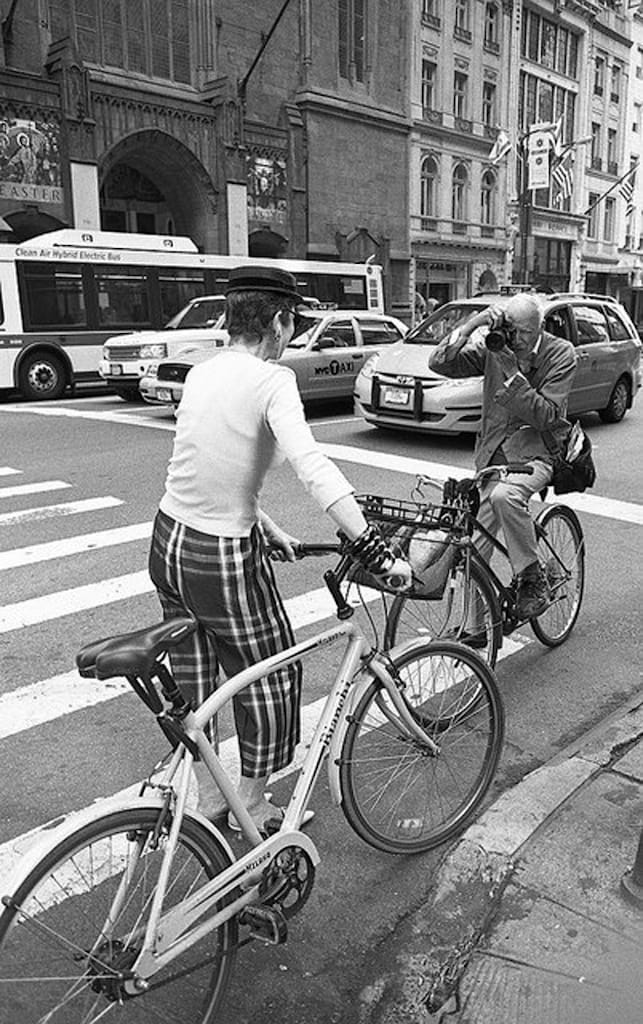
On the streets of Manhattan, he was a familiar sight, his slim, lithe figure gliding skilfully amidst the raucous city traffic on his battered bike; trusty Nikon camera dangling from his neck. Bill Cunningham was an amazingly influential style authority and trend-spotter in the late 20th century. He was a beloved figure on the city’s streets, and in 2009, Cunningham was designated a New York living landmark. He captured the fashion icons of the day; attended museum openings and benefit dinners, in order to document the latest craze. When Bill Cunningham noted an item of fashion interest, headlines followed. (Photo above: Bill Cunningham on his bike – photographing Tziporah Salamon, 2011 Photo courtesy Antonio Alvarez)

Toni “Suzette” Cimino in New York City, 1974 New York HIstorical Society Library, Melanie Tinnelly Collection of Photographs of or by Bill Cunningham and Toni “Suzette” Cimino

Celebrating Bill Cunningham at the New York Historical Society is a wonderful tribute to his eclectic creativity, with a selection of objects, personal correspondence, photographs and ephemera that reflect his life and work. His career began as a milliner with stylish “Willian J” hats, as he described his label. On display at the museum is a beach hat – which even Cunningham described as “a bit outrageous.” His photography stint started in the 1960’s and for fifty years, he photographed and catalogued what New Yorkers wore on the streets. His favourite vantage point was 57th Street and Fifth Avenue – where gilded fashion emporiums Bergdorf Goodman, Tiffany and Bonwit Teller (until the latter was demolished) were certain to attract the “fashionistas” of the era, and Bill could capture the moment with his Nikon.

Ciel Bicycles New York City retailer, Biria Germany est. 1976 manufacturer Bicycle used by Bill Cunningham, ca. 2002 New York Historical Society, Gift of Louise Doktor,

The New York Historical Society has acquired his iconic Nikon camera; the French workers jacket that Cunningham adored for its numerous pockets; and one of his many bicycles. It is estimated that he owned at least thirty bikes over the years; frequently the bikes were stolen.


French workers Jacket worn by Bill Cunningham 2000s Cotton New York
Historical Society

A transplanted Bostonian, Cunningham evolved into the quintessential New Yorker, who was passionate about the city, art and politics. This touching tribute to Cunningham is a reminder of what a revolutionary he was at the time…and how much he is missed. Celebrating Bill Cunningham New York Historical Society Museum & Library through 9th September. www.nyhistory.org JG

Musique et esprit Marseille concerts

France flourishes with summer concerts – classical, jazz, dance, chamber music, and electronic performances. In August, a new event joins the prestigious roster – Musique et Esprit (Music and Spirit), founded by the renowned flutist Gabriel Fumet, (top image) which takes place at the Abbaye Saint-Victor de Marseille, a late Roman monastic structure. Fumet is from a musical family dynasty. His grandfather – Dynam Victor Fumet – was a prolific, accomplished composer; organist; and pianist. And…he had a passion for singing. Gabriel’s father – Raphaël – was also a composer and played several different musical instruments. Gabriel inherited this musicality, and at a young age, started to play the flute. HIs father would compose short pieces for Gabriel to play, and later he entered the elite Paris Conservatory.

Fumet’s career has seen him perform from Salzburg to Saint Petersburg. In Marseille, where his performance is 7th August, his oeuvre will include music from Bach to Rachmaninov, in conjunction with organist Jean Galard, from Beauvais Cathedral. Other concerts will feature the Saint Petersburg Choir, Renaissance music by the Energeia Ensemble, and the Sartène Men’s choir from Corsica. The port city of Marseille is a lovely Mediterranean destination. This summer presents a wonderful opportunity to blend relaxation with exceptional concerts by renowned performers. Let your heart soar! Concert dates and additional information – Musique et Esprit et La Toison d’Art www.latoisondart.com JG

Ocean Liners: Speed & Style at V&A London

The golden age of ocean travel is joyously celebrated at the Victoria & Albert Museum in London with Ocean Liners: Speed and Style. The exhibition is also in collaboration with the Peabody Essex Museum in Salem, Massachusetts, and is the first time that an exploration of design and cultural impact of the ocean liner has been presented. The exhibition investigates the many aspects of liners from the architecture, engineering, and interiors to the chic lifestyle and fashion that was – in the early days of cruising – so much a part of life onboard.

Empress of Britain colour lithograph poster for Canadian Pacific Railways, J.R. Tooby, 1920-31 Victoria &Albert Museum

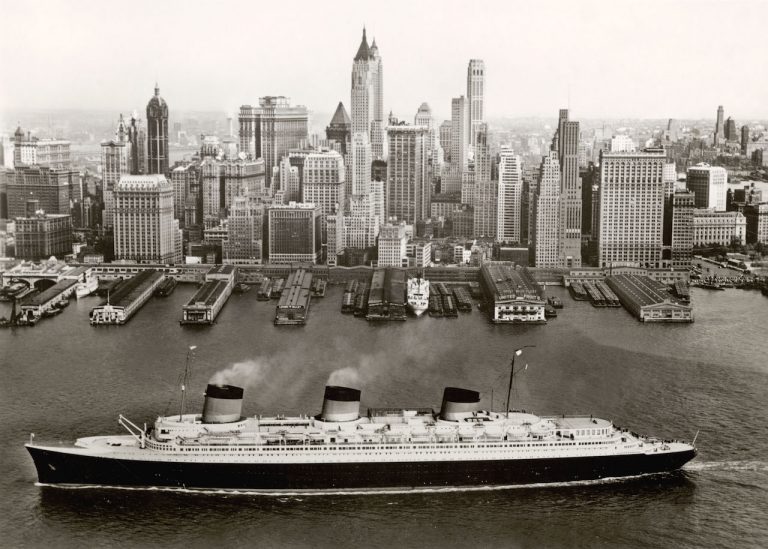
Included in the presentation is a poster of the Empress of Britain – a colour lithograph of the wondrous ship constructed at John Brown & Co. on Clydebank and launched in 1930. The Empress of Britain was the fastest and most luxurious ship of her time operating between Britain and Canada. This poster advertising Canadian Pacific Railways liner demonstrates how companies diversified transport networks and developed the seamless experience of modern travel. The imposing view of a looming hull in movement with its trailing smoke dramatises the sense of scale and speed, with the extreme stylisation typical of Art Deco.

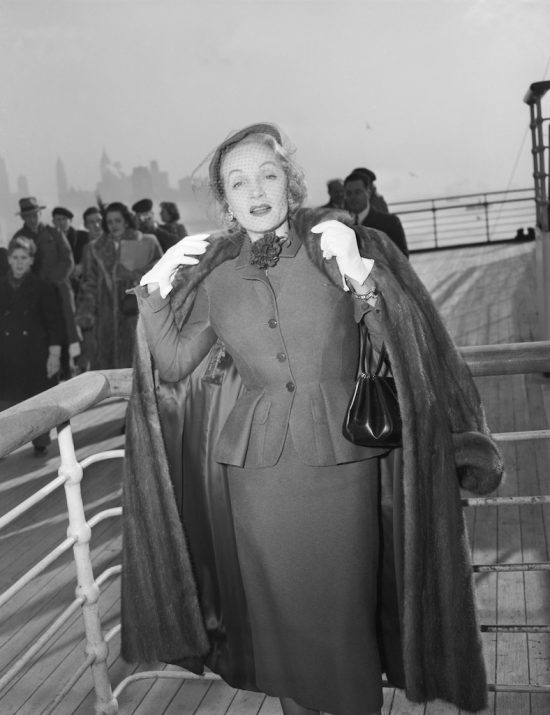
Marlene Dietrich wearing a day suit by Christian Dior on-board Queen Elizabeth, arriving in New York, 21st December 1950. Getty Images

The German born actress, Marlene Dietrich, was one of the famous stars of the age and frequently crossed the Atlantic on liners. She was see wearing Dior’s “New Look” suit arriving in New York on the Queen Elizabeth. Liner companies were quick to publicise stars travelling on board, and Dietrich was often photographed wearing the very latest fashions.

Luggage previously belonging to the Duke of Windsor, Maison Goyard, 1940’s Miottel Museum, Berkeley, California

With the many travel restrictions that exist today – whether by air, land or sea – the emphasis of a different era is highlighted by the luggage that the Duke and Duchess of Windsor used to take on their travels. The elegant couple frequently travelled on liners between their adoptive homes in France and the United States, and travelled with astonishing quantities of luggage. They once boarded the SS United States with 100 pieces. The Duke’s bags were personalised with his title and yellow and red stripes.

Silk crêpe dress worn by Bernadette Arnal on the maiden voyage of Normandie, Lucien Lelong, France, 1935 Paris, Les Arts Décoratifs

The exclusive – and historic opportunity to see the latest fashions – formed an important part of celebrations during the maiden voyage. Leading French couture houses sent representatives for an on-board show, including Lelong, Callot Soeurs, Jeanne Lanvin, Madeleine Vionnet and Charles Frederick Worth. Each showed a garden party dress, a tailored ensemble and three evening gowns. The faultlessly draped red dress above was worn by Bernadette Arnal, the wife of a partner in the shipping company, Worms & Cie, on the maiden voyage of The Normandie. She was a regular client of Lelong and ordered dresses for the crossing in red, white and blue.

Silk georgette and glass beaded ‘Salambo’ dress, Jeanne Lanvin, Paris 1925. Previously owned by Miss Emilie Grigsby. Given by Lord Southborough Victoria & Albert Museum, London

Dining and dancing in the fabulous restaurants onboard was an elegant and nightly pleasure, and women dressed in resplendent couture fashion. The exquisitely beaded flapper dress above belonged to Miss Emilie Grigsby, a Kentucky-born beauty. She became a wealthy New York socialite, and regularly travelled between Europe and New York on the Olympic, Aquitania and Lusitania. An adventurous and fashionable dresser, she patronised the greatest French couturiers and was a regular client of both Paul Poiret and Jeanne Lanvin. Named ‘Salambo’, this dress evokes the exoticism of Gustave Flaubert’s 1862 novel, Salambô, and reflects the wider trend for exotic themes in the 1920’s.

Ocean Liners: Speed and Style sponsored by Viking Cruises, is a remarkable journey of a truly amazing age of travel. At the V&A through 17th June, and then the exhibition continues at V&A Dundee from 15th September to 24th February 2019. www.vam.ac.uk/oceanliners JG

Well-Dressed in Victorian Albany: 19th Century Haute Couture

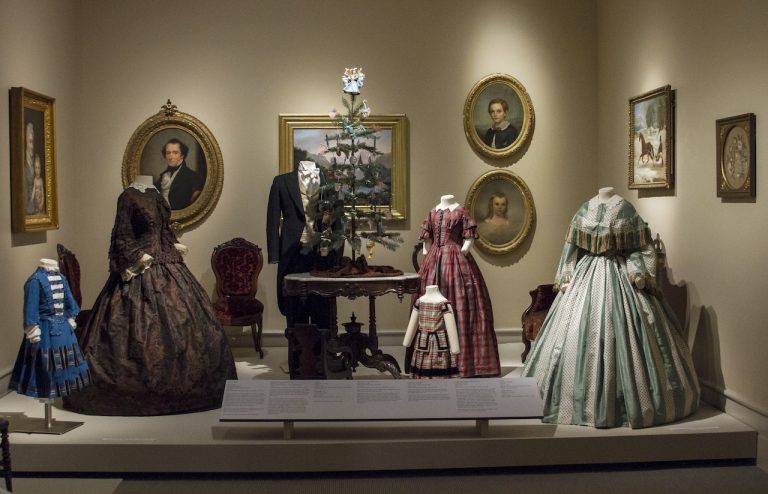
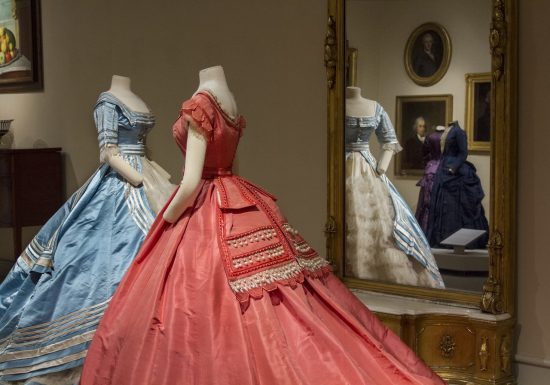
Haute couture on an international scale was flourishing long before the era of globalisation. A fascinating exhibition Well-dressed in Victorian Albany: 19th Century Fashion from the Albany Institute Collection, illustrates how fashion design and changes in style evolved during the reign of the British monarch, Queen Victoria (1837-1901). (Top image:men, women and children’s fashions in a Victorian setting)

Creatively curated by Diana Shewchuk at the Institute, the galleries showcase an extraordinary selection of dresses and accessories of the era, that were purchased in Paris, and also made by skilled home seamstresses in the Upper Hudson Valley. Albany is the capital city of New York State, and Ms Shzwchuk explained: “Many of Albany’s well-to-do families went abroad either for a grand tour experience, or to have daughters presented to Queen Victoria. I think these dresses survive because they were considered masterpieces. The Institute has examples by Charles Frederick Worth; Emile Pingat; Callot Soeurs; Mme Amédée François; and others. The costumes on view tell stories of notable New Yorkers and illuminate their world of fashionable affluence.”

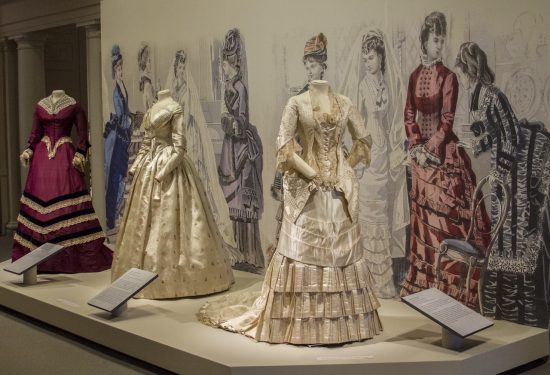
Luxurious materials and lace accent elegant designs in 19th Century fashion

The presentations are displayed on custom carved mannequins. “Everything is surrounded by objects from the Institute”s rich collection of paintings, furniture, and decorative arts which create scenes of nineteenth century domestic life,” noted Shewchuk, “and the addition of art and objects that were made during the Victorian era creates an atmospheric context to the exhibition.”

The vibrancy of the raspberry coloured dress (foreground) was possible with the invention by English chemist William Henry Perkins of the first aniline dye, which transformed colour in fashion.

From wedding gowns (it was Queen Victoria who popularised the idea of white as the colour choice for a wedding gown – women used to wear claret or green dresses) to walking suits, ball gowns and tea dresses, the exhibition presents a selection of extraordinary designs. Garments for both daily life and special occasions reflect the amazing, sumptuous fabrics utilised and include taffetas, shimmering silk satins, plush velvets, lace and luxurious trimmings.

Victorian atmosphere in fashion and home decor. The wicker baby carriage (background) is from the 1890’s.

“Garments like the ones in this exhibition survived because of their sentimental associations, their aesthetic beauty, and sometimes by chance, because they were put away and forgotten,” said Shewchuk. For those who appreciate and love fahsion and social history, these elegant dresses reflect the wide-ranging impact of the Industrial Revolution on the principles, technology, and social history of the time. Continues through 20 May 2018. www.albanyinstitute.org JG

Lovely Waste: Milan Design Week

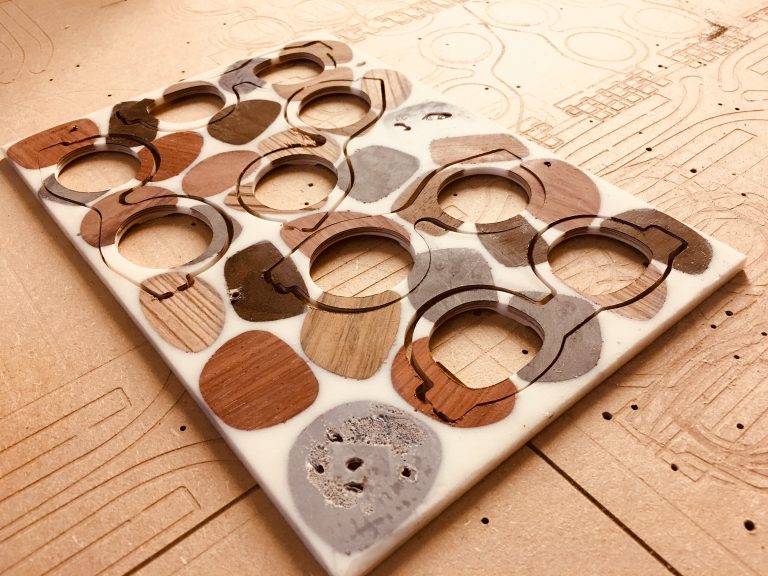
WooClass – the small design focused eyewear label from near Florence was one of the highlights at Lovely Waste, Milan Design Week 2018 – a pilot project from Source, the Italian Design and Networking Agency. The project is the first in a series of events focusing on circular economy strategy, sustainability (product development  and production) and technology. The exhibition focuses on the development of design concepts using production waste, by three product designers: Alberto Ghirarello, Filippo Protasoni and Sebastian Tonelli. Above: Sebastiano Tonelli’s NOVO.

“We put the scraps of our production on the table…to stimulate the designers into working on a different type of process or product…” WooClass

NO LENSES by Alberto Ghirardello

The three designers interpreted, according to their own way of designing, in accordance with the production processes of WooClass, the re-use of the waste materials, suggesting different ways to optimize the production process and / or to make use of the material intended for waste.

Work in progress : MAKI VIEW by Filippo Protasoni
MAKI VIEW by Filippo Protasoni

What emerged is a twofold development: the creation of new accessory products and new ways to experiment with the re-use of waste in the production cycle using it as a new material from which the frames could be cut. For further information, visit WooClass: www.wooclass.com CN