Creative spirits

Daniel Liktor, neubau eyewear

The creative districts dotted around Europe as well as internationally are the most appreciated, curated and diverse locations for fashion, street culture and design – an eyewear brand inspired by such extraordinary places, seems to be no less. Daniel Liktor graduated University in his twenties and began working in bars, restaurants and pubs towards a career in the culinary industry. He then took an interest in cycling, which led him to product management in sports gear and edged him onto the path that would lead him into the fashion industry and the conception of a sustainable, urban spirited, lifestyle brand of eyewear named ‘neubau’.

How did the idea of ‘neubau’ – a brand of eyewear taking inspiration from creative districts and their inhabitants around the world, first come to light?  After Silhouette International took the decision to launch a new brand in 2014, part of the positioning process was to define a clear target group. As we wanted to focus on people with a certain mindset and use a place for the brand story, one came to the other. Austria, urban lifestyle, creativity and a name that can be pronounced all over the world led us to Vienna’s 7th district – named Neubau.

neubau eyewear: model Dominik in naturalPX – (colour stone grey matte)

Was alternative eyewear a gap in the market you have always seen in relation to your particularly creative social circle?   In all honesty no, not always. It was discovered and then developed out of a natural interest and curiosity I had in the area. I started to work with bicycles and other sports gear as product manager and had the chance to dive deeper into several industries, that are kind of linked to fashion. One day in 2014 I received an offer to meet up with the former CEO of Silhouette to talk about a project they were working on. We got along, shared the same ideas and vision, which was definitely linked to some gaps in the market we could see and 5 years later I must say, I definitely took the right decision to enter the eyewear industry.

Did ‘neubau’ always intend to supply sustainable eyewear (as opposed to solely high quality, artistically unique and stylish frames) ?  Yes, it was part of our DNA from day 1, as we had so many positive aspects at our fingertips, that stood out from the masses, like our local production in the centre of Europe, our waste-reducing production processes, and so on. After launching our sustainable plastic material naturalPX in early 2017 the story became more complete and more obvious to everyone.

Did sustainability organically manifest as an important factor due to the ‘urban’, ‘current’ and ‘stylish’ concept of the brand itself as well as its target market?  It absolutely did and does more than ever. Especially in times like today with all these relevant, popular and increasingly influential movements like Fridays for future, Plastic Patrol, just to name two out of many, awareness for the necessity of crucial behavioral changes towards a better future for our planet is rising. To me it is part of our culture.

neubau eyewear: cateye style Virginia

From the perspective of ‘point of sale’ – would you say many customers inquire about the sustainability of ‘neubau’? Is sustainability a prominent selling point that could make or break a sale?  Yes and no. To some the style itself is of more importance than the sustainable component, but those who do want a responsibly produced, sustainable product AND style don’t have to compromise any of those aspects with ‘neubau’. And that is great!

What would you say are the benefits and / or the disadvantages of using 3D printing in the manufacturing of your glasses? To start with the disadvantages, as there are only two that come to my mind, colouring is still very limited, as the process does not allow us to produce translucent plastics. The other is the high investment in machinery and competence to start production. As part of our philosophy is to produce our frames in-house, we had to learn this technique from scratch, which on the other side gave us the chance to re-think certain production processes, that are critical in 3D-printing, e.g. sealing the surfaces to avoid that colours from “bleeding out” or even fungi growing on your frame, and find our own solution for those challenges. In terms of design options, you can be very creative compared to other production techniques and very important to us, the production process produces almost zero waste. We just launched our new 3D-printed capsule collection “Côte du Soleil” produced out of 100% bio-based raw materials; our next step in becoming the most desirable, sustainable eyewear brand out there.

What inspires ‘neubau’ most in particular to either the people or the location of some of the creative districts you have mentioned like El Born in Barcelona or Shoreditch in London?  Both! Creative ideas and an open mindset mostly characterise the people living in those urban areas we like to refer to!

Is the inspiration ‘neubau’ derives from these special places and people used in just the aesthetic features of the range; colour, shape and so on or does it go further than that?  It goes further than that! We try to be as open-minded as possible, one of the characteristics that are typical for those places and its people we really admire. We hope it’s visible in our activities, our collaborations, our communication and last but not least, our products.

Bio-based and 3D printed – model Alain in special edition ‘Côte du Soleil’ by neubau

From reading ‘neubau’s’ Sustainability Guide, I gather the intentions of the brand’s sustainability and good ethics make special emphasis on future generations – what legacy will ‘neubau’ leave as one of a growing number of sustainable eyewear brands, that is different to the rest?  What we share with those of our competition who do care about sustainability too, is the mindset of supporting the environment. What goes beyond the others is our way to link the sustainable world to a certain style, as we believe sustainability can look and feel premium and up-to-date.

Just as ‘neubau’ eyewear beautifully dissects and draws inspiration from the most bustling creative capitals of our world – in the midst of a contagion, one of the most positive culminations of our isolation – where we are limited to little or no exploration, adventure or wandering, is that we have been forced to appreciate the beauty within our own localities and dwellings – some that were once hidden in plain sight. A brand as diverse and continually evolving as ‘neubau’ can be a source of both creative and non-creative inspiration for designers and consumers alike; creativity is an easily identifiable and relatable motif for us all – and that is what helps to set this brand apart from others. Interview by Victoria G. L. Brunton for Eyestylist.com. All rights reserved.

Conversations in lockdown: James Van Vossel

Thinking differently is what puts James Van Vossel apart in the field of eyewear. His work with Belgian label theo began in 2010, and has continued to flourish, alongside an ever expanding portfolio of innovative design products through very different disciplines. Most recently his work has included ‘Hollow’ for Modular Lighting Instruments (www.supermodular.com) and through the current lockdown – when not looking after the kids, he is working on ceramics, lighting concepts and tableware, from a studio style space in his workspace connected to his home.

Hollow by Modular Lighting Instruments: winner of an iF Design Award in 2020

From the theo collaboration, Van Vossel tells me how his work with eyewear continues to grow – always approaching the object “from a different angle”. He refers to one of the most distinctive enduring frames in his repertoire so far – James 6 (launched in 2012), a design which has an integrated ‘folded’ section which forms the nose piece of the design. From the front, the frame appears to have a missing piece. It’s a style that lives on in the theo collections, a reminder of the possibilities of bucking the trend, exploring alternatives, with an experimental ‘hands on’ process using moulds, modelling from life, far removed from what is more normal in eyewear production.

James 6 – first launched in 2012 by theo, worn by Wim, and still an eye-catcher in the collection

In Outlines, the line launched in 2018, James developed a concept based on prototypes crafted to scale – a mode of working that he prefers across disciplines where no predetermined outcome has been laid down. He produced a number of frame design studies in prototypes, giving a sense of the design and material and allowing him to see what works and what doesn’t.

Outlines for theo Sketch – © 2018 copyright protected Artworks,
Photography & Graphic Design!

“In the outline collection the radical and revolutionary step of starting with the shape of the lens was taken, allowing it to determine the further design of the glasses by extending the existing vocabulary of the lenses and allows them to continue into the frame”, he explains.

Outlines for theo Assembly – black and fluo pink

“In a natural way, the frame is then shaped and moulded around it as an outline, as a shadow image around the essence – the glass; thus creating an original tension between the frame and the shadow image.”

Current colorations in the Outlines collection at theo include signature brights, in combinations of black/fluo pink or the more demure black on black.

For more details about all James Van Vossel’s design work visit www.jamesvanvossel.com
For the eyewear collections, visit www.theo.be

Georgiana Boboc, Vintage Traffic

Eyestylist had the pleasure of meeting the delightful and enchanting Georgiana Boboc, one of the first pioneers in what we know now as the “social media influencing” industry, a connoisseur of all things fashion – particularly vintage and arguably one of the most genuine, talented and quirky individuals in the business today.

You are strong and confident in pulling off a plethora of colours and patterns in just one outfit – how do you choose what you wear, and why do you think you are drawn to such exuberant, vibrant materials and textiles? Fashion is ridiculous sometimes. It’s so hard to play with colours, I think you need to, or already be super open to wearing a rainbow and still feel comfortable about it and to own it. I’ve never worn something crazy to be the centre of attention – it’s because it puts me in a good mood; colours always do that for me – I was designed to wear them. Vintage is quite colourful actually; patterns, florals, geometrics – that’s why I’m so drawn to it. Most of my statement pieces are very bright.

Georgiana (above and top) in Demure sunglasses by Delalle

As Eyestylist is an accessories platform – what do you think the importance of accessories is in regards to your personal style / in the industry generally?  Oh my god – EVERYTHING – you can be super basic and just wear a white t-shirt, but as long as you have a sparkle of something; it could be a vintage bag that costs five euros, but it has a nice colour or nice details; brassware or buttons can be the focal point of a look. I have always been about details; matching my socks with the colour of my headband – I used to do crazier things in styling, but now I am a bit more chilled – I’m thirty two years old, I tried to introduce more black into my wardrobe but it’s SO hard.

When did this love-affair with colours and with fashion ignite for you – when did you become involved in the fashion industry? Just after I finished high-school, I lived in Romania so I didn’t have access to a lot of the fashion, but I was passionate about vintage before the craze of American bloggers – I started the Vintage Traffic blog in 2008; I was stuck in traffic, on the way to class – to my degree in Journalism, so it was an outlet to me; it was about women, society, models, the idea of ‘perfection’ and what is demanded of women in general – not just about fashion.

Georgiana : Paris is home

Given Vintage Traffic began as a more general fashion news / societal awareness blog – what is your stance on the drive towards sustainability in the fashion industry? I have noticed one of the biggest agencies in Paris – one that manages and organises the fashion shows for top brands has taken action towards sustainability this Fashion Week; they are reducing the plastic / paper waste of the shows they are running – I think that is amazing. It is essentially the overproduction of useless stuff that is temporary, they don’t mean anything to anyone, and they don’t help much, we are just realising that. I am still receiving envelopes from brands, paper invitations, that is so bad. I am conscious of it; I haven’t bought something new in such a long time – what I wear for Fashion Week, I wear for my daily life. Honestly, I don’t like being the same as everybody else so that’s another reason why I‘m saying NO to fast retailing. I love a Victorian dress with an oversized blazer – mixing antiquity with a flash of modernity, a touch of masculinity with a pinch of femininity, adding something androgynous to it – that’s just my style. If I got married again, I would wear a tuxedo.

Would you be more inclined to purchase from a brand that was higher quality / more expensive but 100% sustainable and ethical?  Yes of course if I was going to purchase an investment piece – that would be a contributing factor. I am vintage addicted, so I don’t put a lot of money into new clothes –but I see and understand the need for new sustainable brands, buying, wearing and selling vintage is a passion. It doesn’t pay – that is why you really need to be passionate about it, I never follow trends, but vintage always comes back – for example, I went through a phase some years ago of collecting the fannypack / bumbag… vintage Moschino, Sonia Rykiel, Kenzo etc… I was constantly criticised for wearing them, and now you see all the top brands reintroducing them and they have become a streetwear trend.”

Georgiana wears DeVour by Delalle – a 1970s infused octagonal frame

You’re very selective about the new brands you purchase or wear and showcase to your following – we have noticed you wearing ‘Delalle’ eyewear – do you remember what drew you to that brand or what you liked about them? I don’t remember if I discovered the brand in an agency or in a showroom or if they had reached out to me personally from the beginning, but anyway, I just love the designs, they’re so powerful, they are WOW! It’s the eyewear that stands out from the crowd. I couldn’t say no to them, they are so funky and cool.”

As our interview came to a close, we discussed Georgiana’s next potential career moves and future developments across a wide array of industries – cinema, costume design, vintage selling, antiquities and many more – after a difficult year this superwoman has truly come out on top and I look forward to our next interview – who knows in what industry that will be, but I wish her every success in whatever path she chooses to take. Interview by Victoria G. L. Brunton in Paris – exclusively for Eyestylist.com – find Delalle sunglasses at www.de-lalle.com

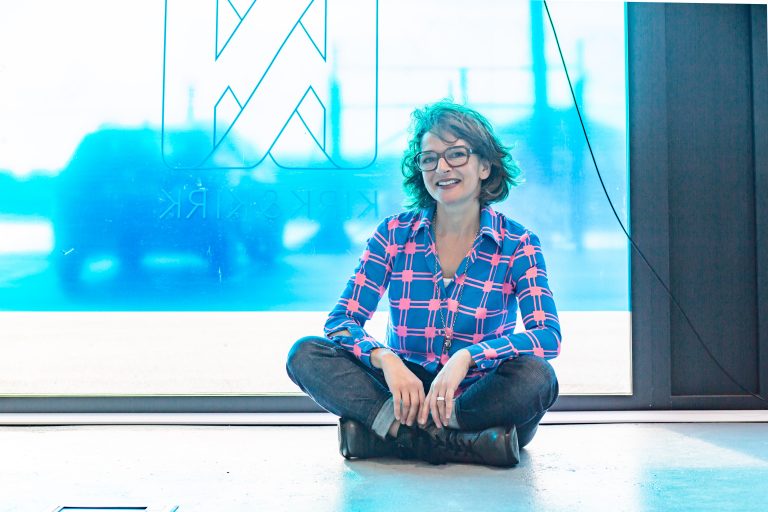
Fine-tuning colour at Kirk & Kirk

British independent label Kirk & Kirk continues to inspire a desire for bright statement colour in eyewear. Co-founder Karen Kirk says push your boundaries, and try something new, you might fall in love!

Using acrylic for frames in its Centena line, Kirk & Kirk can create its own palette of colours. What was your inspiration for the 2020 tones? Do you base the choices on what was selling well or is there more to it?
Acrylic transmits light beautifully, and I will always choose colours that work best with our material. It isn’t really a fashion thing. It’s about people, and the way you feel when you wear the frame. As we have full control over the manufacturing process, we have freedom to create our own subtleties and transparencies in colour; this is a huge advantage, as generally eyewear companies choose from pre-designed sheets from the two main manufacturers.

Esme from the Centena Collection by Kirk & Kirk

What is the difference in wearing a bright matt and a bright shiny frame for the wearer (if any)? Can you offer any guidelines on what tends to suit who? Generally speaking a matt material will sit on the same plane as your skin; shinier materials will have a three dimensional quality. For me, the level of transparency and colour plays a larger part. I would recommend trying different colours on your face as the best way to really tell. Many of our bright colours look amazing on dark skin tones as well as pale complexions. Pale skin can look incredible with a vibrant shade and a dramatic lip tone.

Hana in the Kaleidoscope Collection by Kirk & Kirk

Pink was a hot colour for Kirk & Kirk in 2019. Would you agree and what advice can you give on choosing a pink frame? Yes, and it will continue to be, we have included this colour in new collections coming up! There seems to be an emotional connection to pink, it’s warm, sexy, fun and friendly.
People’s hearts seem to leap for joy (I am not exaggerating here) when they see this colour and it is usually love at first sight. When you choose a pink frame you need to own it, go with it and don’t be afraid to contrast with it. If you’re going hot, don’t be afraid of mixing with a clashing red, it can look amazing.

Centena – Horace in 10mm acrylic – a new matt finish is achieved through sandblasting the frames

Colours in eyewear have generally been hotting up over the last years, but there can be worries or inhibitions over wearing really bold tones in the work place. What would you say to anyone who is a bit nervous about being bold with their colour choice? We hear this a lot, but once you start trying on colour, it is very hard to go back to that pair you were hiding behind before. Once you see the change in the way people react to you, there is usually no holding back.

Kirk & Kirk have just launched the new matt styles in the Centena Collection. They have also released 3 new styles in the Kaleidoscope Collection this week – a cat eye called Michelle, the oversized + angular Penelope, and a beautiful more minimal and understated two-tone Jane frame. For more information visit www.kirkandkirk.com or view the newly released presentation of the new models for SS20 by Jason Kirk on YouTube at https://www.youtube.com/watch?v=X69vaOmrCnY

Tim Williams, YR

Globally known as the ‘kings of customisation’ and the go-to fashion tech company for all things personalised including apparel, footwear and accessories, YR was launched seven years ago by Welsh school friends, Tim Williams and Tom Hogan. The company has worked with a wide spectrum of brands, as well as high-profile fashion labels – Michael Kors, Nike and Ralph Lauren are among their client list – and has offices in New York, LA, Hong Kong and Tokyo.  They are on course to turnover £10m this year. Eyestylist spoke to Tim Williams, Co-Founder.

Customisation continues to be a very hot topic in fashion. Can you outline how YR started and how the business has evolved? We started in 2013 as a custom fashion brand – a consumer brand that enabled anyone to come into a YR store and easily create designs on tees, sweatshirts and accessories and then watch as they were printed in just a few minutes. We were very early adopters of experience first retail – no printed inventory in the store, so everything was made on-demand, and the whole theatre and excitement of creating the item and then seeing it come to life live, in-store was really something unique.

YR opened multiple stores all over the world – but sadly it was a difficult business, none of us were experienced at fashion retail and it was tough without serious investment. So, we repositioned what we did and went B2B – helping other brands bring on-demand and customisation to life in-store, at events or online. Now we have 5 offices in London, LA, New York, Tokyo and Hong Kong and work with brands on all manner of projects – big and small – all over the world. It’s quite the evolution!

You have worked with global fashion retailers including DKNY, REEBOK and L’Oreal. What has been your most exciting creative project to date? That’s a really hard question and actually the answer is, the most creative time was when YR was a consumer brand. It was exciting that we could make decisions and release artwork packs and see how customers liked them, with live feedback talking to them and seeing their reactions. We worked with some great artists in our London stores; one personal favourite was LA illustrator Bob Motown who loves pizza and cats. Commercially my favourite creative project was working with Liberty where we brought Liberty prints to life on scarves and t-shirts in the iconic London store. Customers could use the patterns to make new designs and add their own touches, it was really incredible to be able to delve into the archives.

YR x Lagerfeld: A tribute to Karl: The White Shirt Project

Are you a creative or a tech geek? Who brings the creative direction to YR? I think I am creative, it would be hard not to be and get where we are. But, I don’t think its either/or when it comes to tech – there are plenty of creative techie people. I guess I am one of them, I understand the technology but also have a love of creativity, art and design. My business partner and long term friend, Tom, is both creative and highly technical – so not only is Tom heading up our software side but he also drives the creative concept of the business alongside me.

What is your view of how this direction in customisation will further evolve? Made-to-order, bespoke and custom products date back hundreds of years – the great tailoring tradition used to be the preserve of the rich and now, YR, and many others are working hard to make customisation and ‘one of one’ manufacture a reality for mass goods. So I think this is just the beginning. Evolution will take many forms – today, in-store you use touchscreens to make or tweak designs, maybe that will be more gesture or voice-controlled in the near future. The production techniques are moving forward rapidly as machine manufacturers understand this new need for smaller, more nimble machinery. I think there are lots of new production techniques and customisation options on the horizon, not previously possible. Jewellery and accessories are a large area that has a lot of potential. I think 3D printing will come of age and be quicker and better than ever. More importantly, I think consumers will cherish their custom made products more than ever as we strive to have less ‘stuff’ but better and more meaningful relationships with clothing and accessories. The future is exciting!

YR: Collaboration with Bathing Ape in Selfridges, London

As a company, with offices far afield, what is your key focus? Is sustainability something you think about? Of course, the global nature means there are some elements of travel that are not good for the environment. That is an issue for us as a business. But, we are enabling a more sustainable future – one reason is the answer above – we want consumers to fall in love with their items and cherish them, something that bespoke and customisation really encourages. As we start 2020 on-demand production and a move away from just customisation is key for YR. That means that instead of a customer choosing a pre-made item, the item is made just for them when they want to buy it. This hugely reduces waste and eliminates stockpiles over time. Sustainability and reduction in oversupply is a key reason we do what we do – we are working alongside some of fashion’s biggest brands to make them more sustainable whilst improving the customer experience.

What inspires you personally? I love building the company and doing something that people love. At YR we put our team first, which means we grow and learn and get better, together. That’s inspiring. Also, I love new ways of doing things and being creative with finding solutions. I’m passionate about turning the traditional business model of fashion on its head and I am constantly inspired by the people I meet.

Do you enjoy being in the fast lane of the new directions in fashion and on demand production? Sometimes. Ha. That’s the truth, really. It’s great when it’s great, but being in the fast lane or on the leading edge of anything opens you to issues and there is no proven path for what we are doing. That can cause customers to have very high expectations – which is not always fun. However, for the large part, it’s great – thinking we have helped shape a market that didn’t exist before us (in-store design via large screens) is interesting. Having our tech running all over the world feels good, and most of the time cancels out the stress of the demanding side of being in the fast lane. Find out more at https://thisisyr.com

Interview written by Clodagh Norton