Eyestylist

| Eyestylist 11th December 2019

We Are Annu: 3D printed

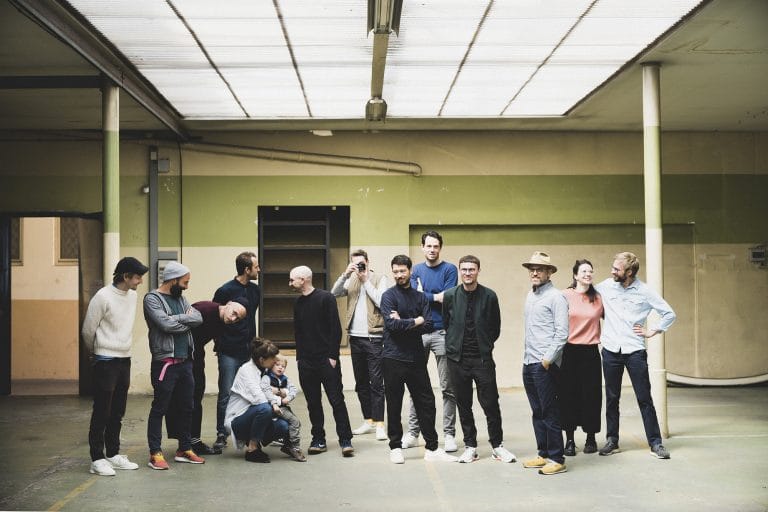
Emerging label We Are Annu represent the new-generation of innovators in 3D printed eyewear from Germany. Having created their brand amongst friends four years ago, they are now evolving their output and creative direction through shared values, commitment to quality and a genuine desire to innovate. The brand currently specializes in durable, lightweight 3D-printed frames and uses a screwless titanium “Clip” hinge which lends a flexible and robust structure to the design. They also offer a choice of temple size and nose pad, giving an adaptable fit for all face shapes and sizes.

We are Annu is a start-up with a particular design and philosophy. Can you explain how you set up and who the team is? We started in summer 2016, and over the past three years, the team has grown from a single person alone in a workshop, to a group of eighteen of us. Most of whom are also shareholders. We developed it this way because we wanted to create a team of young people who could make something happen together and at the same time, for themselves. Our sense of ownership and responsibility to one another is what makes our brand unique. And this approach has proved a success for us – over and over again.  

We Are Annu: flexible, hard-wearing and lightweight – made in Nuremberg, Germany

As a young, creative company, what are your aspirations? Our focus is simple, we aspire to make the best possible product. That is why we spend considerable time on the details, working and reworking solutions. Our approach is that of continued refinement through an iterative design process because we want to continue to make it better. The end goal for us is design-simplicity, executed with intelligence and mastery – which isn’t easy to achieve. If we succeed, that will be another story. But for now, we keep hold of the idea as a belief and a working process to keep chasing – we push ourselves forward.

We Are Annu: sleek Japanese titanium temples

What has your experience been so far as a start-up in this business? It is a very competitive market, so we have to choose carefully where to put our energy. And for us, it’s the product, the customers and the opticians every time. These are the most important things to us. Good people and good products. We are now looking forward to establishing long-lasting relationships and forging new ones as we grow our business, and so far, it has been amazing.

It is incredible to think that we only launched in opti in 2019, so we are not even a year old officially. And we have found ourselves on this super exciting journey with so many great people.

From where do you draw inspiration? We are very passionate about creativity and culture and draw inspiration from many places. Art, design, music, the whole creative spectrum really. At the root of this, are the folks behind the work, this is what we are inspired by, people.

We are currently developing an exciting platform called Friends of Annu, and this is where we present the stories of interesting people we know and like. It is still in its infancy, but we hope to build it into something comprehensive. Eventually, it will become an editorial archive of real people and their stories. It is partly a labour of love, but we think a good one.

We Are Annu: glasses with minimal proportions

Are you working together in one office or are you in different places?  Both really, we are a German company based in Nuremberg, and we have an office and workshop here, but we also have members of our team who work remotely out of Amsterdam, Tel-Aviv and Berlin.

We try to meet at least three times a year for full team workshops and to communicate daily through different communication and productivity platforms. It is incredible how connected we are by technology, it has revolutionized how we work and what we can achieve.

What are your plans for 2020? We are looking forward to each and every step along the way. Like I said earlier, we are dedicated to the details and are in a constant process of development – in all areas of our business. It could be design innovation, R&D, brand design, sales, manufacture, the team, everything. It’s all happening.

We have a new collection to present at the Munich trade fair in January. We will be showing what we believe to be the lightest eyewear on the market, and the frames are absolutely beautiful. Find out more: https://weareannu.com  Clodagh Norton interviewed Iddo Zimmermann, Co-Founder, We Are Annu.

All rights reserved.
| Eyestylist 10th December 2019

Reinventing vintage: ‘pince-nez’ inspiration

Art Deco Vintage Oxford: TVR® (True Vintage Revival), Japan

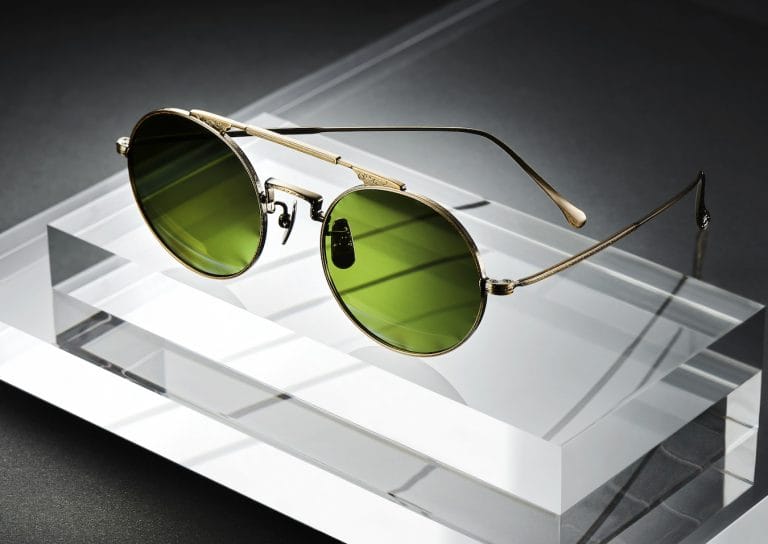
Inspired by the classic pince-nez spectacles from the early days of the Renaissance and the late 1800s, when eyeglasses became a highly popular style statement amongst the bourgeoisie, the two new models from the Japanese independent label TVR® work on transforming much loved antique styling into 21st century wearable design. The frames are made in Sabae, Japan, the heart of eyewear production in the country and a place that is revered for its level of artisan quality, workmanship and traditional handcrafting. Above: The new TVR® 525, a round eye shape available in a selection of colours, including antique gold or silver.

Inspiration: a pince-nez without temples, c late 1800s.

Both TVR® 525 (top) and TVR® 526 are also the brand’s first collection made entirely in pure Japanese SPM. From the frame to the temples and bridge, the exquisite round and Panto shapes are patented in the material for exclusivity. The metal temples are also engraved with intricate gold-filled design akin to original vintage Art Deco patterns, worked upon by master craftsmen with exceptional skill and know-how.

TVR® 525 (round shape) + TVR® 526 (panto shape): inspired by the “Oxford” spectacle style of yesteryear

Developed by Shintaro Kato in 1930 in Japan, SPM is a precious metal alloy. It was a rare commodity at that time, and cherished by Japan’s Showa royal family for its hardiness, resistance and compatibility with human skin. As such, the export of raw SPM material was not permitted at the time. Today, its remarkable characteristics make it popular in dental accessories and tools for plastic surgery, and TVR® is one of few labels who use it with creativity and passion in eyewear. Despite the name, SPM doesn’t contain platinum — instead, it refers to the soft platinum colour after it has been polished. More importantly, the material retains its shine even after a long period of time. The 68-year-old master craftsman Kanamaru Harumi is behind the production of the two new SPM metal frames from TVR® (True Vintage Revival) – Japan. Find out more about the brand TVR® at www.tvropt.com

| Eyestylist 9th December 2019

Independent eyewear: Paradigm 19-11

A brand new line with a youthful vision, committed to independent eyewear style for everyday wear: Paradigm is offering a striking balance of style and value, with “something for everyone” in terms of details and tonal combinations. Launched in 2019, the collection offers a series of modern everyday basics, like the 19-11 geometric shape, in well-matched contemporary materials and colorations with a twist. Model 19-11 combines an acetate rim inside a thin metal structure – produced in gold or rose gold (as a sun or optical style). Top image: Model/stylist Garret Gooch (www.garretgooch.com) wears Paradigm model 19-11. 

Paradigm model 19-11

The independent Paradigm brand was designed by a team of creatives at Kenmark Eyewear (USA) – to be very diverse, fitting a wide variety of faces, ethnicities, ages and personal styles. For more details visit the Kenmark website at www.kenmarkeyewear.com

| Eyestylist 4th December 2019

Swiss design, Sol Sol Ito: 044 DF

Swiss design label Sol Sol Ito has some memorable shapes amongst its ‘Original’ collection, of which the 039 and 035 are two of the standout shapes (find more of the models at https://www.eyestylist.com/2019/05/sol-sol-ito-captivating-sun-styles-that-sizzle/). This month, another standout one has joined the series, based on a classic teardrop pilot shape with a beautiful double bridge. A close inspection reveals a slight lift on the upper rim and a svelte ‘sculpted’ lower rim, typical of the 1970s (both the acetate and metal designs in this genre).

044 DF: the makings of an icon at Sol Sol Ito, Switzerland

Colours at Sol Sol Ito come together as if from an artist’s palette, with some of the most outstanding yet subtle graduated tones we are currently seeing and a choice of rich hues as well as transparent ‘crystal’ pastel tones. The new 044 DF frame is offered in hand polished yellow-green, brown-orange and beige-gold – paired with the lightweight modular ‘click-in’ temples,  the design of which Sol Sol Ito has become especially well-known.

Sol Sol Ito glasses and sunglasses are produced by design duo Monika Fink (designer/sculptor) and Sandra Kaufmann (co-head, industrial design, Zurich University) in Switzerland. Their sun and optical collections are stocked by some of the finest opticians worldwide including Auerbach & Steele (London). For more details and further stockists, visit www.solsolito.com. Above: Photography for Sol Sol Ito by Hans Hansen.

| Eyestylist 3rd December 2019

John Lennon’s glasses in London auction

Sotheby’s to auction items from across The Beatles’s career including iconic Oliver Goldsmith wire-framed sunspecs

Described by the auction house as “The most iconic sunglasses in rock and roll history”, the round metal rimmed glasses were given to Lennon for a role in the film ‘How I Won the War’ and caught on as his signature look. They later came into the possession of The Beatles’s’ chauffeur, Alan Herring, left behind in the back of his Mercedes.

John Lennon sunglasses by Oliver Goldsmith c. 1966 – owned by chauffeur Alan Herring and now going to auction

“In the summer of 1968 I had picked John up with Ringo and George in Ringo’s Mercedes and driven the boys into the office,” recalls Herring. “When John got out of the car I noticed he’d left these sunglasses on the back seat and one lens and one arm had become disconnected. I asked John if he’d like me to get them fixed for him. He told me not to worry, they were just for the look! He said he’d send out for some that fit. I never did get them mended – I just kept them as they were as John had left them.”

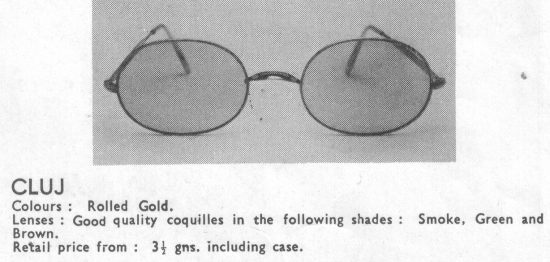
Archive image of model Cluj – which was available in three colours. Image by kind permission of Oliver Goldsmith Sunglasses

The glasses themselves were a version of the model ‘Cluj’ (see above) and an example with the same gold finish is still to be found in the Oliver Goldsmith Sunglasses London archive, according to Claire Goldsmith, Oliver’s great granddaughter and custodian to an extensive rare collection of Oliver Goldsmith original frames with a rich and fascinating history. Claire said: “John Lennon was renowned for his eyewear and in particular the round metal frames we made for him. To be the brand that designed them is something we are very proud of.”

An original silkscreen poster, 1200 x 905mm., c.1967, pinholes in each corner (from the Apple Boutique) – with reference to John’s iconic round eyeglasses

The Beatles sale includes a number of other curious items including the psychedelic portrait of Lennon by Larry Smart (above). Also up for sale are a semi-acoustic guitar owned by George Harrison (guide price £40,000 to £60,000), shirts worn by the band, a parking ticket, and a collection of items from the homes of The Beatles, which include a toaster.

In 2007, a pair of Lennon’s sunglasses – worn during the band’s 1966 tour of Japan –  were expected to fetch £1 million pounds, according to The Telegraph. The final amount paid for the glasses was never disclosed.  (https://www.telegraph.co.uk/news/uknews/1559161/John-Lennons-sunglasses-sold-at-auction.html).

The Sotheby’s auction takes place online from 2pm GMT on 6th December 2019 – 13th December 2019. For more information visit www.sothebys.com . All rights reserved. Photography: @ Sotheby’s Auction House / PA

Note after publication: the frames sold for £137,500 in the auction in December 2019.